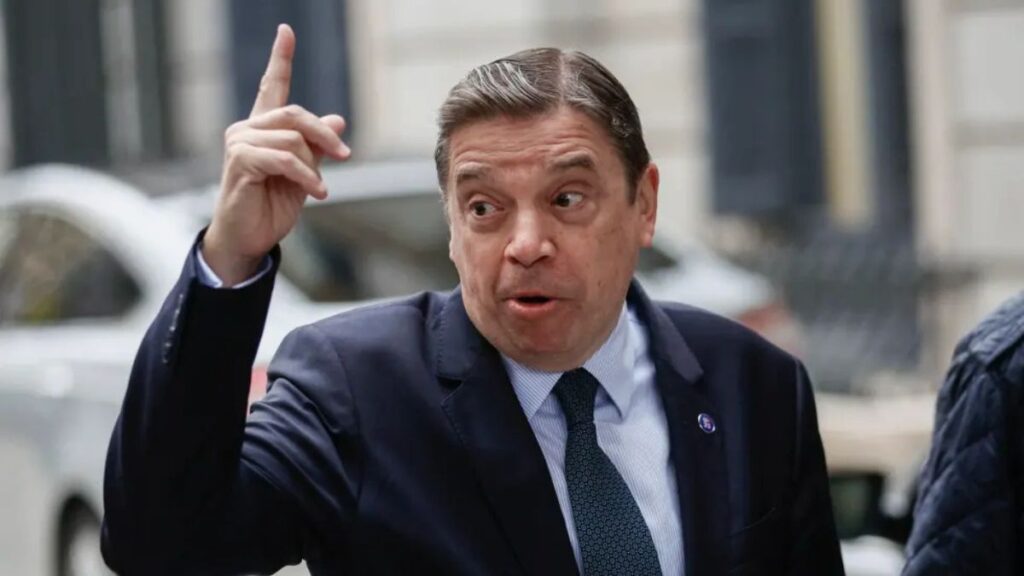
The Government meets this Monday with representatives of the agri-food and fishing sector to analyze the economic impact derived from the conflict in the Middle East and evaluate possible measures to support farmers, ranchers and fishermen.
The Minister of Agriculture, Fisheries and Food, Luis Planas, will begin the day with a meeting with the fishing sector, in which representatives of the Spanish Fisheries Confederation (Cepesca) and the National Federation of Fishermen’s Guilds (FNCP) will participate. The fishing employers’ associations have already announced that they will demand that the Executive urgently adopt compensatory measures to avoid stoppages in fishing activity due to the exorbitant increase in production costs.
Among their main demands is the implementation of mechanisms to reduce the cost of fleet fuel, the increase in the limits of state aid per vessel, and not per company, and the possibility of temporarily suspending or reducing the VAT applied to fishing products.
After that first meeting, Planas will participate together with the Minister of Economy, Commerce and Business, Carlos Body, in a meeting with representatives of the Spanish Federation of Food and Beverage Industries (FIAB), as well as with organizations in the fertilizer and feed sector.
The round of contacts will continue in the afternoon at the headquarters of the Ministry of Agriculture, where the head of the department will meet with the main agricultural professional organizations, Asaja, COAG, UPA and Unión de Uniones, as well as representatives of Agri-Food Cooperatives.
An economic plan against the energy crisis
These meetings are part of the Government’s strategy to design a package of measures to cushion the economic consequences of the conflict in the Middle East. Last Thursday, the Executive already held a high-level meeting with unions and business organizations to address possible economic and social protection measures.
The first vice president and Minister of Finance, María Jesús Montero, the second vice president and Minister of Labor, Yolanda Díaz and the third vice president and Minister of Ecological Transition, Sara Aagesen, participated in that meeting, along with the Minister of Economy and the Minister of Social Security and spokesperson for the Executive, Elma Saiz.
After that meeting, Carlos Body announced that the Government is working on a royal decree law aimed at mitigating the effects of the crisis, which would include fiscal measures to contain energy prices and specific aid for two of the sectors most exposed to increased costs: the countryside and road transport.
However, the Executive seems to rule out for the moment the reintroduction of some measures applied during the energy crisis derived from the war in Ukraine, such as the generalized bonus of 20 cents per liter of fuel or a new reduction in VAT on food, although the Government assures that it continues to evaluate all options.
Energy and ecological transition as the axis of the response
As explained by the Minister of Economy, the plan prepared by the Executive will be based on four pillars and will combine structural measures with fiscal actions to reduce the impact of the energy crisis. Among them, the promotion of renewable energies, electrification and the ecological transition, which the Government considers “life insurance” to reduce energy dependence and cushion future geopolitical crises.
At the same time, the Executive plans to approve measures aimed at minimizing the cost of electricity and energy, with the aim of preventing the rise in energy inputs from ending up being passed on to the final prices of food and the economy as a whole.
The final design of the package will depend, according to the Government, on how the international situation evolves in the coming weeks and the real impact that the escalation of tension in the Middle East has on energy markets and supply chains.