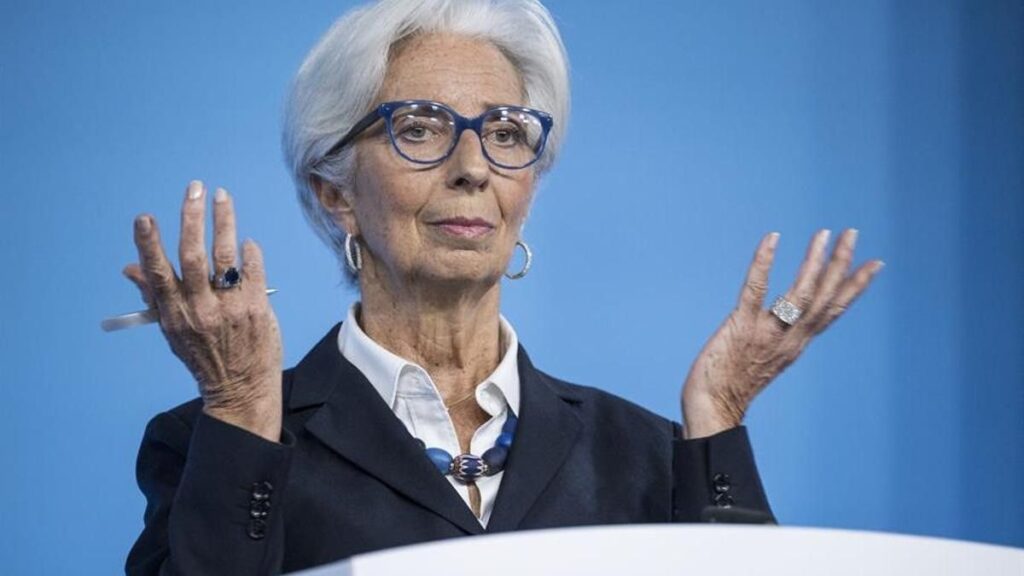
The European Central Bank (ECB) decided this Thursday to keep official interest rates unchanged for the sixth consecutive time and has reaffirmed its commitment to placing inflation at 2% in the medium term, in a context marked by the war in the Middle East. The institution has warned that the conflict is generating upward pressure on prices, especially for energy, and is increasing uncertainty about economic growth in the euro zone.
In the statement published today, the Governing Council has indicated that the evolution of the conflict has introduced new risks for both inflation and economic activity. In particular, he highlighted that the rising energy prices has had a direct impact on short-term inflation.
Despite this, the ECB has stressed that the euro zone economy has shown resilience in recent quarters, supported by a solid labor market and inflation expectations that have remained stable in the long term. Likewise, the institution has indicated that it will continue to evaluate the data that become known to gauge the scope of these effects. “The Governing Council has been closely monitoring the situation,” he noted.
Interest rates and monetary policy strategy
The ECB has kept interest rates at 2.00% for the deposit facility, 2.15% for the main refinancing operations and 2.40% for the marginal lending facility. At the same time, it has confirmed that the APP and PEPP portfolios have continued to gradually reduce, as maturities were not reinvested.
The Governing Council has insisted that its strategy has been based on a data-dependent approach, with decisions taken at each meeting without setting a specific rate path. Likewise, he recalled that he has instruments such as the Transmission Protection Instrument, intended to act in the event of tensions in the financial markets that may affect the transmission of monetary policy.
Economic forecasts and risk scenarios
In addition, the organization chaired by Christine Lagarde has presented new macroeconomic projections, which have incorporated information available until March 11, already reflecting the initial effects of the conflict. Headline inflation has stood at 2.6% in 2026, 2.0% in 2027 and 2.1% in 2028, while core inflation has reached 2.3%, 2.2% and 2.1%, respectively.
These forecasts have meant an upward revision compared to December, especially in 2026, due to the increase in energy prices and its progressive transfer to the rest of the prices. In parallel, economic growth has shown moderation, with GDP of 0.9% in 2026, 1.3% in 2027 and 1.4% in 2028, affected by the impact of the conflict on raw materials markets, real incomes and global confidence.
The organization has also analyzed alternative scenarios for a possible prolongation of the war. In these cases, a persistent disruption in energy supply could have led to higher inflation and weaker growth. According to the ECB, the medium-term implications have largely depended on indirect effects, such as the transfer of energy costs to prices and wages.