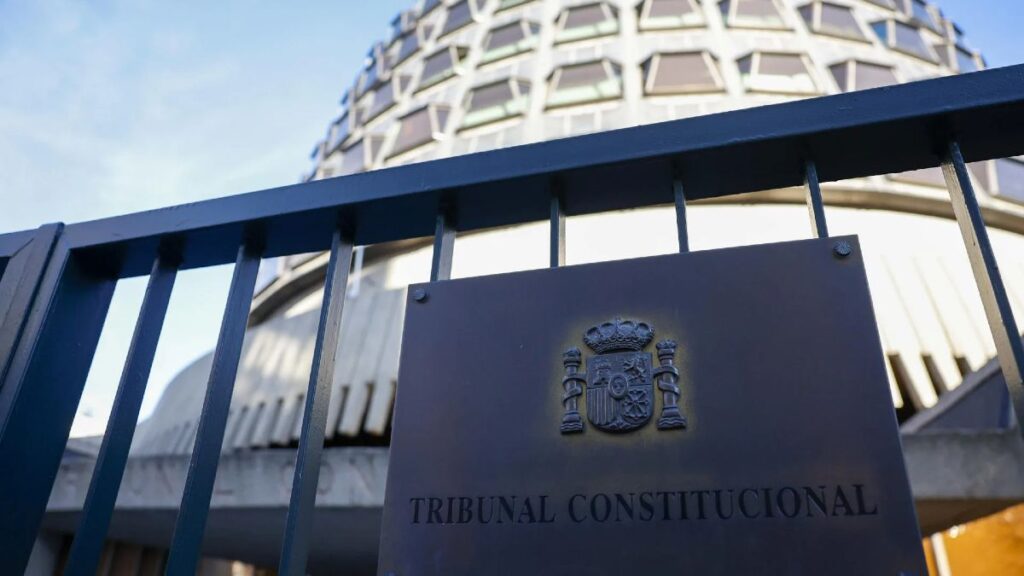
The Constitutional Court (TC) has admitted to processing the conflict of powers raised by the Senate against the Government for not having presented the draft General State Budgets (PGE) corresponding to the years 2024, 2025 and 2026, despite the fact that Pedro Sánchez himself assured that they were going to present the PGE 2026. The decision, communicated this Tuesday by the court of guarantees, opens an unprecedented procedure: it is the first time that the body analyzes a clash between constitutional bodies due to the omission of the Executive in budgetary matters.
The appeal was promoted by the absolute majority of the PP in the Upper House, which defends that the Government has failed to comply with the constitutional mandate of preparing and presenting public accounts for the last 3 consecutive years. According to the Senate, the Executive has not only stopped presenting the bill, but has also successively extended the 2023 Budgets, which, in its opinion, distorts the parliamentary function.
For the majority of the PP, the Upper House “should not admit or tolerate non-compliance” with the obligation that the Constitution imposes on the Government, “which has a constitutional duty to budget.”
The Constitutional Court will study both the alleged omission of the duty to budget and the extensions agreed for 2024, 2025 and, where appropriate, 2026. The Senate considers that this procedure could violate various precepts of the Constitution by preventing the Cortes Generales (and in particular the Upper House) from exercising their function in the approval and control of public accounts.
Non-compliance with the principle of budgetary legality
The PP has described the practice of budget modification derived from the absence of new PGE as a “fraudulent practice” carried out “outside Parliament” and contrary to the principle of budgetary legality. In the document presented to the TC, the popular ones maintain that “there is no possible justification” for not presenting the Budgets, “except for not having been able to reach an agreement with the parliamentary forces with sufficient weight to ensure their approval.” In his opinion, “political reasons cannot be used to justify the Government’s failure to comply with constitutional obligations.”
The conflict of powers requests that the TC declare that the Executive has violated the constitutional competence of the Senate to participate in the approval and modification of the Budgets and to exercise control of the Government’s action. Likewise, it requests that the unconstitutionality and nullity of the extensions of Law 31/2022, on the General State Budgets for 2023, which have taken effect since January 1, 2024 and in subsequent years, be declared.
The admission for processing does not imply a ruling on the substance of the matter, but it does open an institutional debate on the limits of the budget extension. The Constitution establishes the obligation of the Government to present the Budget bill annually, although it also contemplates the automatic extension of the accounts in the event of non-approval of the new ones.
The closest precedent dates back to 2020, when the Executive decided not to present new Budgets in the context of the crisis caused by the Covid-19 pandemic and the 2018 accounts were kept extended. However, the current case introduces a differentiating element: the reiteration of the extension for several consecutive years without a comparable exceptional situation.
The resolution finally adopted by the Constitutional Court could more precisely delimit the scope of the duty to budget and the legal consequences of its eventual non-compliance, with direct implications on the balance between the Executive and the Legislative.