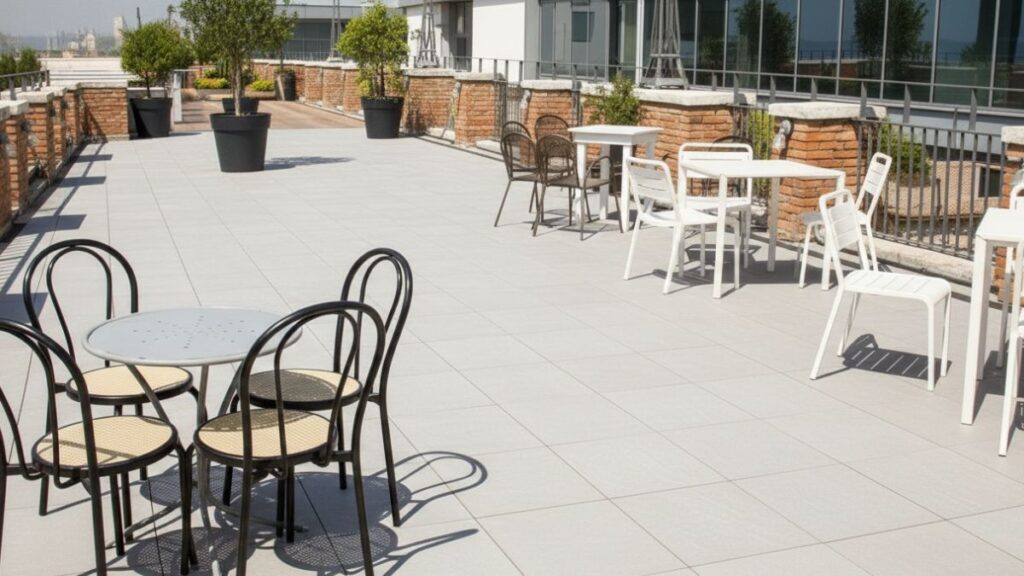
The Supreme Court has confirmed that having a municipal license to install a bar terrace, in itself, does not give the right to occupy common areas of a community of owners. If the community does not consent to such use or decides to withdraw it through a valid agreement, it may demand the removal of tables, chairs and other itemseven if the business has all the administrative permits in order.
This is established in its ruling STS 139/2026, of January 20, 2026, in which the High Court resolves the conflict that arose between a community of owners and a bar that used a common space of the building as a terrace based on a municipal license. It ratifies the sentence to remove all elements of exploitation (chairs, tables, barrels and umbrellas) with the obligation to restore the space to its previous state, as stated in the minutes of the community agreement that prohibited such use.
The Supreme Court makes it clear that the municipal license and the right to use a common element belong to different legal levels. The administrative license certifies that the activity complies with municipal regulations, but it does not replace or prevail over the internal regulations of the community of owners.
The horizontal property law requires respect for the common elements of the building.
According to the ruling, article 9.1 a) of the Horizontal Property Law requires respect for the general facilities and common elements of the building. At this point, the Supreme Court recalls the doctrine already established in STS 658/2008, of July 3, in which it was established that the use of a common element for a purpose other than that intended requires express authorization from the community, even if there is no material alteration of the space.
The Court gives special importance to the fact that, in this case, the community of owners agreed in a meeting to withdraw the authorization for the placement of the terrace in the common space. That agreement, the ruling emphasizes, was not challenged within the legal period, so it became final.
In accordance with article 18 of the Horizontal Property Law, community agreements must be challenged directly and within the deadline by the owners. In line with its previous jurisprudence (STS 1957/2006, of October 19, 2005, and STS 2079/2004, of April 21), the Supreme Court insists that it is not valid to question a firm agreement indirectly when the community goes to court to demand compliance.
Another relevant aspect of the ruling is that the bar was rented, but the High Court confirms that the community can direct its action not only against the owner of the premises, but also against the person who occupies it, when it is that person who uses the common element without authorization. At this point, it refers to its consolidated doctrine, reflected, among others, in STS 839/2009, of December 18, in which it was admitted that tenants can be sued directly when they are the ones who misuse a common element, since this means guarantees the effectiveness of the replacement of the space to its original state.