
Spain is concerned about the high absenteeism from work, and this despite the fact that during the first three days no type of financial benefit is received. This mechanism of “leaving the first days unpaid” was intended to reduce casualties, but according to a report prepared by ifb and DataPulse Research, based on harmonized OECD data, shows that Spain is going in the opposite direction. Spain appears with almost 4.9 weeks of sick leave per year among full-time employees, well above the European average of 2.6 weeks, despite the fact that its system is among the toughest at the start of the season. temporary disability.
The OECD itself explains that this statistic is constructed with surveys of the active population and measures annual weeks of absence due to illness, also adjusted to correct the underreporting common in this type of surveys.
The data from Spain is striking because it dismantles the idea that “because you don’t get paid the first few days” then workers don’t quit. In addition, less is charged, since Social Security establishes for common illness and non-occupational accident a benefit of 60% of the regulatory base from the fourth day to the twentieth, and 75% from the 21st, so it is charged less than in other neighboring countries. The comparative study highlights precisely this paradox: Spain usually maintains the first three days without benefits and, even so, registers one of the highest numbers of absence due to illness in Europe.
Spain, among the countries with the lowest losses despite the initial cut
The European ranking managed by the report places Norway at the top, with 5.9 annual weeks, followed by Finland, with 5.0. Spain occupies third position, with 4.9 weeks, ahead of Slovenia, Portugal and France. Germany, which has been the protagonist of much of this discussion in the last two years, remains at 3.6 weeks and occupies seventh place. The comparison, therefore, does not describe an exclusively German anomaly, but rather a much more heterogeneous map in which Spain appears among the countries with the longest sick leave.
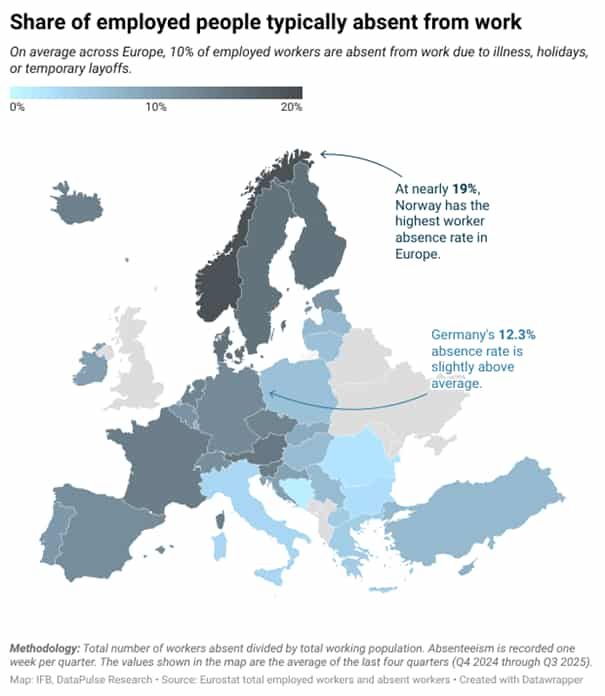
The central study of the analysis is that there is no clear pattern between economic hardness of leave and lower absenteeism. What’s more, the report itself gives Spain as an example, where it has a harsher system at the beginning of the decline, close to five weeks per year. On the other hand, Lithuania pays 100% of the benefit from the first day and has 1.5 weeks. With this it can be said that the disease does not act as a determinant. Now, penalizing the payroll can lead to certain types of behavior.
There is another thing that stands out about the report and that is that low numbers are not always good news. That is, in countries like Romania or Greece, where the declared absence is minimal, it may be due to job insecurity and less social protection (fear of being fired for sick leave) and this should not necessarily be linked to a healthier working population. In other words, coming to work sick can distort the statistics, but it cannot improve the health of the workforce or the real quality of employment.
What really drives the absences
If removing money from the benefit is not sustainable, it is worth looking at the factors that do matter. The report identifies three major drivers in the German case, which can be extrapolated to the European debate: the greater weight of respiratory diseases since the pandemic, the rise of mental health problems and the disproportionate impact of long processes. According to the AOK, musculoskeletal pathologies accounted for 19.8% of the days lost in 2024, respiratory pathologies 15.1% and mental pathologies 12.5%. In addition, sick days linked to mental health have increased by 47% since 2014.
The third factor is decisive to understand why the debate often misses the mark. In Germany, less than 6% of the working population accumulates absences of 29 days or more, but this group accounts for just over half of all sick days. That is to say, the economic problem is not generated so much by very brief processes as by prolonged disabilities, often associated with complex, chronic or slow recovery pathologies. Therefore, focusing the entire discussion on the first two or three days of sickness is equivalent to attacking the least decisive part of the phenomenon.
What happens in Spain with the casualties?
It can be said that Spain is the clear example of the contradiction, since during the first days nothing is charged, but that does not mean that the volume of cancellations is high. The comparison with Europe shows that it should be considered in moral terms, as if the worker decided to get sick based on the salary discount, but in terms of public health, work organization and management of the system.
Furthermore, we must not forget that in Spain the deterioration is both quantitative and management. AIReF explains that between 2017 and 2024 the incidence of sick leave due to common contingencies increased by 58.4% and the average duration by 14.8%. In absolute terms, episodes went from 4.7 million in 2017 to almost 8.6 million in 2024. The organization maintains that temporary disability presents governance deficiencies and proposes strengthening supervision, institutional coordination and information systems, instead of reducing the debate to a linear penalty for the worker.