
Pensioners who charge the complement to minimums in the pension should know that if they travel outside of Spain they can do so, but cannot exceed 90 days, since overcoming it can cause the loss of this aid. This is established by the General Social Security Law, which explains that to collect this complement, obligations such as effective residence in Spanish territory must be fulfilled.
The complement to minimums is an economic amount that is added to contributory pensions (retirement, permanent disability, widowhood or orphanhood) that do not reach the minimum set by law. In this way and regulated in article 59 of the General Law of Social Security (which can be consulted in this Official State Gazette), it seeks to ensure that pensioners charge the minimum pension. Now, being, so to speak “a care aid” it is necessary to meet a series of requirements both to access the benefit and to maintain it, the residence being one of them.
You may be interested
A retiree (67 years old) who worked all his life: “Before I volunteered to the church dining room, today I will help me with food”

The average retirement age is 65.3 years in Spain, but those who retire at age 61 do so with a pension of 2,134.48 euros
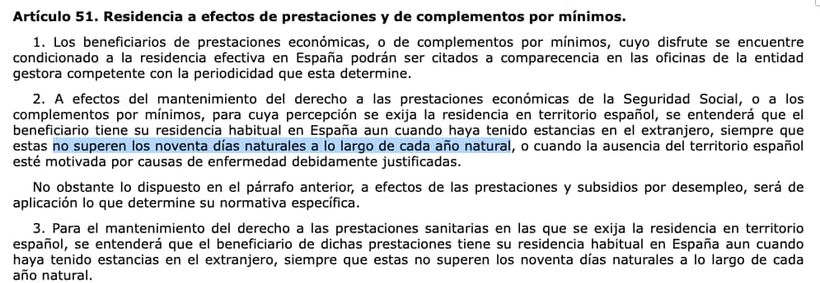
In this sense, the law is clear when defining what is considered “habitual residence.” According to article 51.2, a beneficiary maintains this condition even if he makes trips abroad, “provided they do not exceed ninety calendar days throughout each natural year.” The only exception to this rule is the absences motivated by “duly justified disease causes.” Therefore, any journey through leisure, family visits or personal motifs that exceed that natural quarter in the annual calculation puts the collection of the complement at risk.
What happens if I exceed 90 days of travel?
In the event that a pensioner exceeds the 90 -day limit of stay outside of Spain, Social Security will proceed to suspend the payment of complement to minimums. The administration understands that one of the essential requirements for its maintenance has been breached, which is the effective residence in the country.
The procedure can start in several ways. The managing entity has the power to quote to appear to the beneficiaries to verify that the residence is maintained. If the pensioner does not go to the appointment for being outside Spain, or if by other means (such as the crossing of data with other administrations) the prolonged absence is detected, social security can agree on the precautionary suspension of the payment.
Once suspended, the pensioner will not return to the complement until he accredits his habitual residence in Spain, that is, it must be clear that the suspension is temporary. If the documentation occurs later than required, the law establishes that the rehabilitation of payment will have a maximum retroactivity of ninety calendar days. This means that, in practice, the right to complement will be lost during the time that exceeds that regularization period.
Example on the loss of complement to minimum by trip
To understand it, let’s give the following example. A retiree who charges a pension of 700 euros and receives a complement to minimum of 427.60 euros to reach the minimum established pension (1,127.6 euros). In March, he decides to travel to Argentina to visit his family and return to Spain in July, having been out 120 days.
By exceeding the 90 -day limit, breaches the residence requirement. Social security, having constancy, notifies the suspension of the complement. From that moment, your pension is reduced to the 700 euros that correspond to your contributions, losing the 150 euros per month of the complement.
To return to it, the retiree must communicate to Social Security his return and prove that he has restored his residence in Spain. However, the months in which he was on a trip and in which the complement was suspended will not be paid retroactively in its entirety, since the law imposes limits on the retroactivity of rehabilitated payments. This implies a direct economic loss for not having planned your stay abroad in accordance with the regulations.