

Social Security will raise the involuntary early retirement age again in 2027, thus being the last increase within the reform included in Law 27/2011. In this way, the maximum advance over the ordinary age to retire involuntarily will be 63 years (that is two months more compared to 2026), but with the possibility of maintaining 61 years of age only for those workers who demonstrate a minimum of 38 years and six months of contributions during their professional career.
Involuntary early retirement is regulated in article 207 of the General Social Security Law. This mechanism allows access to the pension for up to a maximum of 48 months (four years) with respect to the ordinary age, but requiring a minimum of 33 years of contributions. On the other hand, it is not required to comply with the specific deficiency, that is, the requirement of having at least two years of contributions within the last fifteen years prior to the causative event (generally when the pension is requested) to access the ordinary retirement pension.

Change in retirement: the CJEU forces the benefits of arduous work carried out in other EU countries to be recognized in the pension

Workers who have contributed less than two years in the last fifteen will be denied the ordinary retirement pension.
This modality is designed for cases of layoffs, ERE or similar situations where the worker has lost his job for reasons beyond his control and is a few years away from retiring. As it is difficult at that age to find work, Social Security offers this modality and prevents the worker from falling into the risk of not meeting the specific deficiency of the ordinary one; since, otherwise, the situation could arise that you could not access any modality even if you comply with the requirement of generic deficiency (for leaving the last years without contributing, although knowing that you can subscribe to a special agreement).
Looking ahead to 2027, when the ordinary age is definitively set at 67 years, the involuntary early age will also be 63 years for those workers who do not prove a long contribution career.
Involuntary early retirement age in 2026
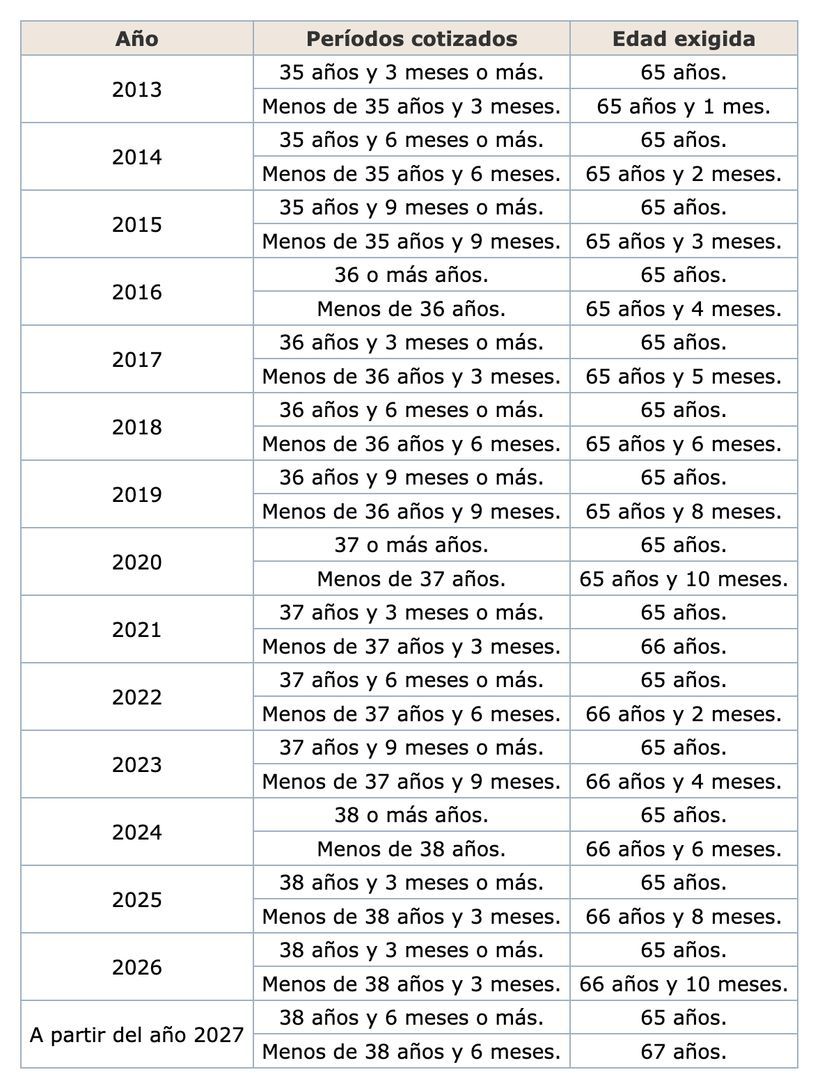
In 2026, the minimum age for forced retirement will be set at 62 years and 10 months, but for those who prove 38 years and 3 months or more, the minimum age is 61 years. In 2027, it will rise and the fixed ordinary age will be 67 years.
| Year | Quoted periods | Retirement age |
|---|---|---|
| 2025 | 38 years and 3 months or more | 61 years |
| Less than 38 years and 3 months | 62 years and 8 months | |
| 2026 | 38 years and 3 months or more | 61 years |
| Less than 38 years and 3 months | 62 years and 10 months | |
| From 2027 | 38 years and 6 months or more | 61 years |
| Less than 38 years and 6 months | 63 years |
It must be kept in mind that involuntary early retirement is not “free”, that is, Social Security will apply some reducing coefficients in the form of a percentage of the final amount of the pension. The percentage will depend on the total years of contributions and the months ahead of the ordinary age, which can reach up to 30%.
Involuntary early retirement age based on age at birth
Knowing our age at birth and the total number of years of contributions, we can determine the year in which we will be able to access involuntary early retirement. This information can be consulted in the following table (the year may vary depending on the month of birth):
| Year of birth | Involuntary early retirement date (with 38 years and six months or more of contributions) | Involuntary early retirement date (with less than 38 years and six months of contributions) |
|---|---|---|
| 1964 | 2025 | 2027 |
| 1965 | 2026 | 2028 |
| 1966 | 2027 | 2029 |
| 1967 | 2028 | 2030 |
| 1968 | 2029 | 2031 |
In this way, those born in 1964 and 1965 can access involuntary early retirement if they prove those minimum years of contributions, while those born after 1966 must wait until 2027 and following, when the minimum age will be definitively set at 61 or 63 years depending on the years of contributions. In this sense, saying that Social Security has on its website a autocalculation simulator with which to know how much we will have left in our pension.