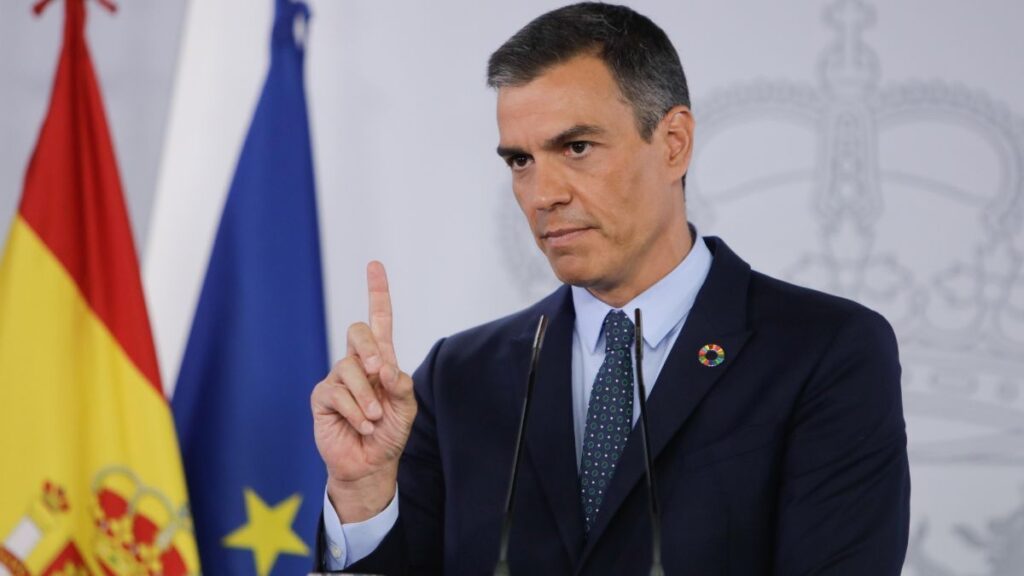
The President of the Government, Pedro Sánchez, announced this Tuesday that Spain will prohibit access to social networks for those under 16 years of age and will substantially toughen the legal responsibility of digital platforms and their directors when they do not remove “hateful and illegal” content.
The measures, which will be approved next week in the Council of Ministers as anticipated Europa Presswere presented during his speech at the World Government Summit held in Dubai.
Age verification and hate speech monitoring
The regulatory package will force platforms to implement “effective” age verification systems and not only through voluntary declarations as is the case now. It also contemplates the creation of a system for “tracking, quantification and traceability” of hate speech, baptized by the Executive as “Footprint of Hate and Polarization”, which will serve as a basis for future sanctions.
In addition, the Government will work together with the Prosecutor’s Office to investigate possible legal violations committed by companies such as Grok, TikTok and Instagram.
A global digital governance problem
Sánchez framed these measures in what he described as a global problem of digital regulation, which, in his opinion, no country can solve alone. After highlighting the good data of the Spanish economy, the president directed his speech to the negative effects of social networks.
“We were promised that social networks would be a space for cooperation and freedom, but the opposite has happened,” he said, describing them as a “failed state” in which algorithms distort public debate and facilitate the spread of illicit content.
The Chief Executive cited recent cases to support his diagnosis: from accusations against TikTok for tolerating accounts that spread child abuse material generated with Artificial Intelligence, to the use of X to amplify misinformation, to investigations into Instagram and Facebook related to digital espionage practices or electoral interference campaigns. “All these cases are real and represent only the tip of the iceberg,” he stressed.
Criminal liability and protection of minors
One of the main novelties announced is the criminal liability of platform managers. The Government will modify the legislation so that those most responsible can respond legally if they do not act against illegal content, in line with the tightening of the legal framework on the use of social networks, which provides that from 2026 certain behaviors may give rise to sanctions and lawsuits.
Likewise, algorithmic manipulation aimed at amplifying misinformation or illicit speech will be criminalized. “No more hiding behind the code or pretending that technology is neutral,” Sánchez warned.
The prohibition of access to social networks for minors under 16 years of age has been presented as a protection measure against an environment that the president described as “addiction, abuse, pornography, manipulation and violence.” “Our children are exposed to a space that was not designed for them,” he said, while defending the need to impose “barriers that work” to guarantee compliance with the rule.
Aware of the limitations of unilateral action, Sánchez has also announced the creation of a European coalition of countries to coordinate the regulation of digital platforms, whose first meeting will be held soon. “Spain is moving from words to actions,” he concluded, appealing to choose “governance over resignation” in an area that he considers key to democratic and social health.