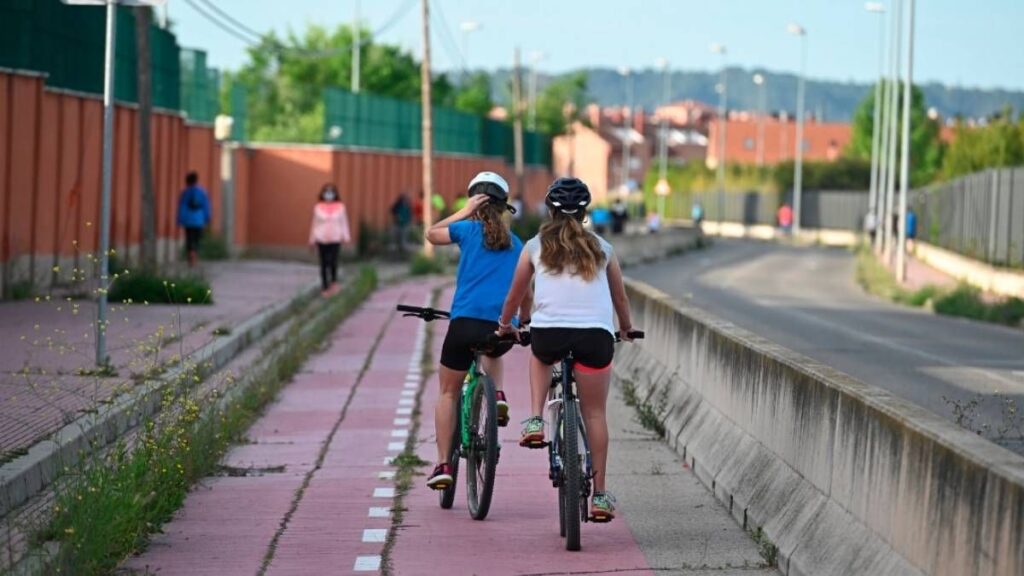
The Government announced, together with the Minister of Transport, Óscar Puente, an investment of 900 million euros in Spanish roads. So far so good, the problem is that this investment is not intended to fix the poor condition in which a good part of Spanish roads are found, but rather to create new bike lanes and new pedestrian paths.
The news broke with what many might expect, since Spanish roads are in a catastrophic situation after recent storms and also due to years of neglect, which could well be fixed with part of that money instead of allocating it only to improving the suitability of these roads for pedestrians and cyclists.
Specifically, the Ministry of Transport reported that the investment will be aimed at the integration of pedestrians and cyclists on urban and interurban roads and will cover more than 140 Spanish roads, located in almost 40 provinces.
Pedestrianization and new bike lanes
As explained by the ministry itself, part of these items will be used to pedestrianize certain sections of roads and enable new bike lanes. These actions have a budget of 247 million euros and include more than 62 interventions, of which 44 have already been completed.
As stated in the document, the objective of these investments is to reduce the intensity of traffic and adapt the roads to facilitate the movement of pedestrians and cyclists. To do this, sidewalks will be widened and walkways, pedestrian crossings, green areas and new bike lanes will be built.
Tunnel modernization
The investment plan also includes 325 million euros (VAT included) to update different tunnels, with improvements in lighting, ventilation and signaling systems, in order to reinforce security.
In addition, the ministry will allocate 255 million euros (VAT included) to 61 projects focused on reducing the environmental impact of roads both in urban areas and in natural spaces. These actions seek to increase energy efficiency and reduce noise. Added to this is another 20 million euros to build a bus-HOV lane to access Barcelona via the B-23 motorway.
Finally, the department headed by Óscar Puente has launched an interactive map on its website so that citizens can consult the main works in progress, with images and videos that show their evolution until completion.