Australia has established itself in recent years as one of the preferred destinations for young Europeans looking to combine work and travel for a while. Sectors such as agriculture, hospitality or mining They offer temporary jobs linked to work and holiday visas, although working conditions can vary greatly depending on the company, the area or even the climate.
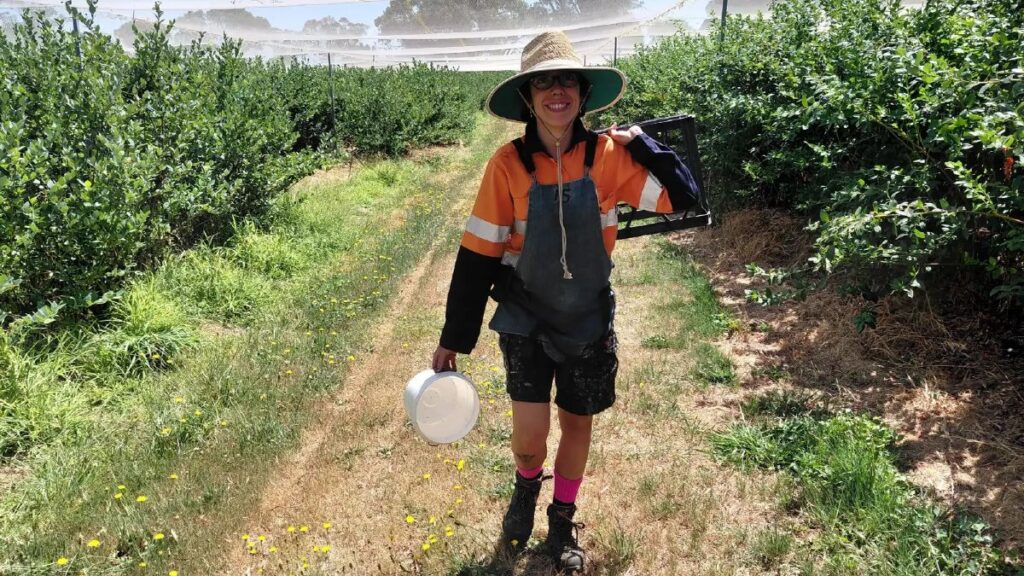
Among those who have tried this type of work is Nerea, a young Spanish woman who works temporarily in the Australian countryside and who has shared his experience on social networks under the username @nereaexplora. In one of his videos he explains how much he earned during a blueberry harvesting campaign that lasted five weeks.
The result, he says, is a departure from the image of big salaries often associated with working in Australia. He earned 2,078 euros net for more than a month of intense physical work and very high temperatures.
“2,000 euros for five weeks of bending your back under the sun,” summarizes the young woman as she reviews week by week what she earned during the campaign. In total, he points out, he received 3,451.11 net Australian dollars, an amount that is equivalent to approximately 2,078 euros at the exchange rate.
Irregular income during the campaign
The season began with a relatively positive week, in which he earned 923 Australian dollars. However, the situation changed in the second week, when he barely earned $224. “Instead of a salary, the boss gave us a little alms so we could buy rice and pasta,” he comments ironically in the video.
In the following weeks, income continued to be variable. In the third he won 898 dollars, in the fourth, which was conditioned by several days of rain, he received 680 and in the fifth 723 dollars.
A system without salary stability
As he explains, he works under a contract called casuala common modality in Australia for temporary jobs. This type of contract offers a somewhat higher hourly remuneration than that of permanent workers, but in exchange it lacks many of the usual guarantees.
In his case, the base salary was 29.38 Australian dollars per hour, although the final income depends on numerous factors. “If you get sick, you don’t get paid. You don’t have vacations, if it’s too hot you don’t get paid, if it rains you don’t get paid either,” he explains.
In agricultural work, furthermore, weather conditions directly influence the activity. When it rains, blueberries become wet and cannot be picked normally. “If you put them in the bucket so wet, they will rot and are of no use,” he points out.
Extreme heat and physical work
Added to this instability is the harshness of the environment. During some days of the campaign, temperatures reached maximums of between 41 and 45 degrees, according to the figures that the young woman herself shows in her video.
Agricultural tasks, such as picking fruit for long days, also require significant physical effort. “Financially it is not worth it,” Nerea concludes, although he clarifies that his decision to accept the job was not motivated solely by money.
A job linked to the visa
As with many young foreigners in Australia, agricultural employment also has a bearing on visa requirements. This type of work allows you to accumulate the days necessary to extend certain temporary visas, something common among those who wish to extend their stay in the country.
Furthermore, the young woman highlights the personal component of the experience. “We are working with our friends,” he explains, stressing that he also valued the possibility of sharing the experience and continuing to travel.