

Although the price of gold has fallen again this week, it is still at a high price and remains the most important safe haven value for thousands of investors. That is why any discovery of this precious metal is transcendental for whoever finds it, now more than ever.
Well, this is what happened to some workers who, while working on the construction of a highway, found piles of treasures buried underground that have possibly been there since 400 BC. The discovery of gold is what caught the attention of these workers the most, although there were also silver coins, jewelry and Baltic amber, according to what he says. the medium Indian Defense Reviewwho shared the information.

How much does a gram of gold cost in Spain, today May 20

How much does a gram of gold cost in Spain today, May 13
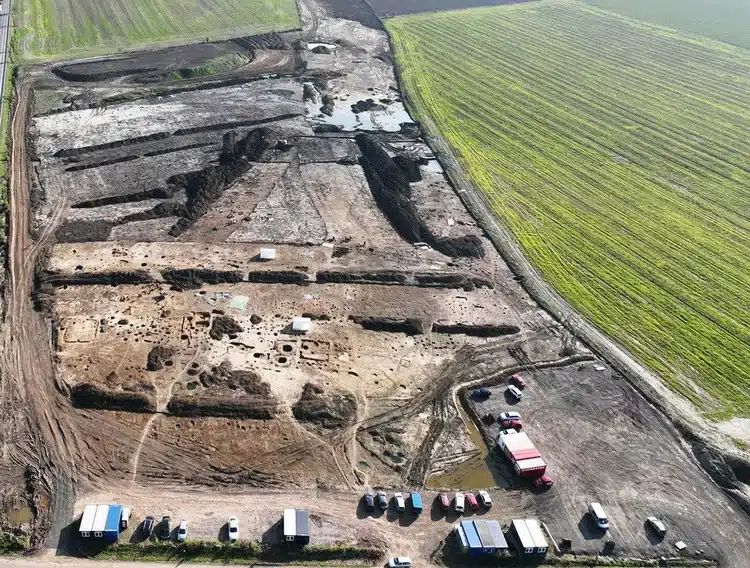
It all started when bricklayers were carrying out prospecting work for a future highway in the Czech Republic and in the middle of this work they found a 2,200-year-old Celtic settlement, where the treasures were. Archaeologists say the site, located near Hradec Králové in the Czech region of Bohemia, is among the largest Celtic archaeological discoveries ever recorded in the area.
The settlement covers an area of 62 acres, an area similar to that of some 4,500 parking spaces. To give you an idea of its magnitude, most of the Iron Age sites documented in the region are barely between 1 and 2 acres in size. It was the highway construction project that required a topographical survey that would probably never have been carried out otherwise.
Chief archaeologist Matouš Holas recalled the moment when the team began to understand the importance of what was under their feet. “When we began the first work, we found artifacts that indicated that we had discovered something important,” he declared, according to a statement from the Houston Czech Center Museum. “If the road had not been built, this settlement would not have been found.”
Thousands of objects come to light after two years of excavations
The excavations continued for two years and uncovered an exceptional set of finds. Investigators recovered gold and silver coins of different sizes, more than 1,000 pieces of jewelry, including brooches and glass beads, as well as mirror fragments.
Metal vessels, finely crafted ceramics and Baltic amber beads also appeared, a material especially valuable in the commercial networks of the time.
In total, archaeologists filled more than 13,000 bags with materials from the excavation. The small coins seem to be inspired by Roman models from the same period. Its manufacture, along with the quality of the jewelry and ceramics, points to the presence of specialized artisans who lived and worked in the settlement itself.
The production tools and structures found reinforce this idea. It was not only a community dedicated to the exchange of goods, but also a place where high-value goods were manufactured. Among them, luxury ceramics stood out, which consolidates the image of this enclave as an important Celtic center of production and trade.
An enclave without walls in the middle of the Amber Route
One of the most striking aspects of the site is the absence of a common element in many settlements of its time: fortifications. No defensive walls have been found around the site, suggesting that its inhabitants may have prioritized trade over conflict.
The settlement was located next to the historic Amber Route corridor, a trade network that connected the Baltic Sea and the North Sea with Central Europe. Raw amber traveled from the northern regions to the south, passing through communities like this one and continuing its journey to the Mediterranean.
Archaeologist Maciej Karwowski, from the University of Vienna, pointed out that the set of luxury objects found fits with other known points on the Baltic amber trade route.
For his part, Tomáš Mangel, professor of archeology at the University of Hradec Králové, summarized the importance of the settlement clearly. “The settlement was a supra-regional center of trade and production connected to long-distance trade routes, as demonstrated by finds of amber, gold and silver coins, and evidence of luxury ceramics production,” he said in a translated statement.
The diversity of recovered materials reflects the role that this place played within a broad network of exchange. It functioned both as a craft workshop and as a transit point for goods that circulated throughout much of the European continent.
La Tène culture and a still open mystery
The settlement belongs to the La Tène period, which developed approximately between 450 and 40 BC. C. This stage left as a legacy a rich tradition of metal work, highly elaborate decorative motifs and evidence of long-distance commercial contacts throughout Europe.
Historians have long linked Bohemia with the Boii tribe, from which the region gets its name. However, this relationship is based more on historical tradition than on conclusive archaeological evidence. At the Hradec Králové site, no inscriptions, cemeteries or tribal markers have been found to confirm which Celtic group its inhabitants belonged to.
Mangel approached this question with caution. “Traditionally, Bohemia is closely linked to the Boii. But recent research shows that we can only say that the Boii settled somewhere in Central Europe,” he declared. For now, the exact identity of those who lived there remains unresolved.
La Tène culture is widely documented in Europe. Classical authors recorded its expansion into Central Europe around 400 BC. C., although biological studies on migratory patterns are still limited.
An abandonment without signs of violence
The settlement became uninhabited around the 1st century BC. C.. However, archaeologists have found no evidence of violent destruction. There are no layers of burned soil, weapons deposits or mass graves that point to an episode of conquest or attack.
In the absence of signs of violence, researchers consider it more likely that abandonment was related to economic decline or environmental changes. Even so, the archaeological record does not allow us to offer a definitive explanation as to why this community disappeared.
Several institutions participated in the excavation, making it the largest archaeological project of its kind carried out so far in the Czech Republic. The recovered materials are being studied by researchers from the University of Hradec Králové and collaborating entities.
This site contributes a key chapter to the knowledge of ancient Celtic settlements in Central Europe. Their findings reveal a community organized around artisanal production, commercial exchange and long-distance routes, rather than around military power.