The workers who are missing their work in Spain every day are increasing and already reaches record figures without counting the exceptional years of the Covid-19 pandemic. According to the data published by the consultant Randstad, during the first quarter of 2025, 7% of the working hours were lost, which is equivalent to 1,523 million people did not go daily to their job. That is, if we apply it to terms of active population, they do not say that this assumes that 6.8% of those employed lacked their employment every day.
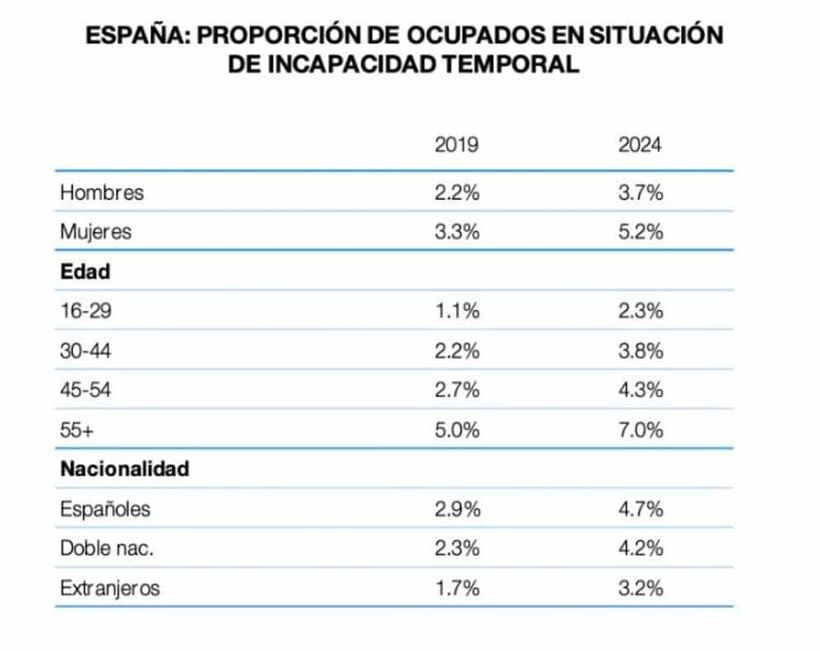
Most of these absences are due to medical casualties by Temporary inabilitywhich affected 1.19 million daily workers, 8.2% more than in the same period of the previous year. The problem is transversal, although with notable territorial and sectoral differences. Canary Islands (7.6%), Basque Country (7.2%) and Cantabria (6.7%) lead the absenteeism rates by communities, while activities such as mails (11.9%) or random games (11.3%) lead the classification by sectors.
You may be interested
Susana (79 years): “I charge a pension of 800 euros and 600 rental payment, what is left for light, water and gas … is impossible”

Light price today, August 16 for hours: when is cheaper and more expensive in the day
Social Security expense for low temporary disability was triggered 91.6%
The economic impact is considerable. The Association of Mutual Occasion Accidents (Amat) estimates that the direct cost for companies derived from common contingencies will exceed 32,000 million euros, 10% more than 2024. If indirect costs are included (such as the benefits paid for social security or the loss of productivity of the companies) of the consultant Grant Thornton.
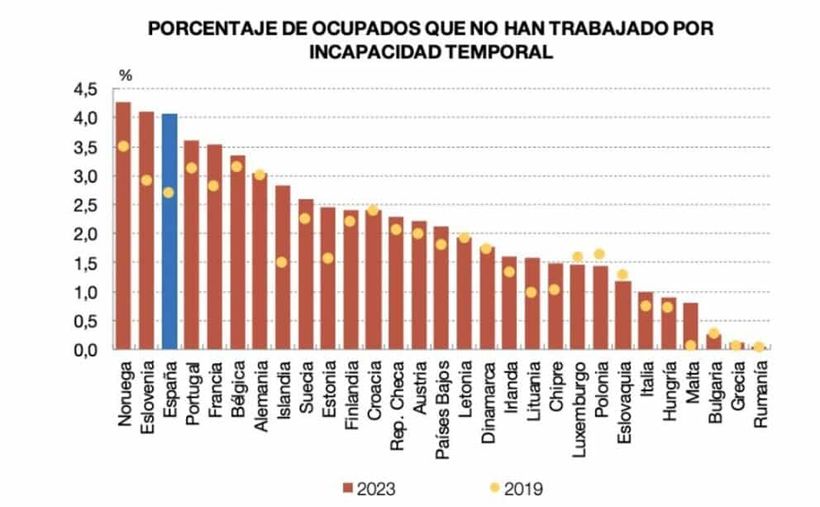
This is not a new phenomenon, since between 2019 and 2023, the social security expense in temporary disability benefits was shot 91.6%, as the former Secretary of State for Social Security Octavio Granado recalled in an analysis published by the Foundation of Applied Economics Studies (Fedea). Granado warned of “abuse” in the use of medical casualties and warned of the growing pressure that this departure exerts on public accounts. In the European comparison, Spain is among the countries with the highest proportion of the population of low labor, only behind France and Portugal, according to data from the Valencian Institute for Economic Research (IVIE).
The absenteeism has fueled the political and social debate. The employers criticize the recent expansion of labor permits in a context of “unprecedented absenteeism”, while the unions underline the incidence of waiting lists in public health and demand more resources to accelerate the recovery of workers.
The Government promises changes in the casualties due to temporary disability
The Government, on the other hand, has begun to involve mutuals in the management of the casualties. These entities may not grant medical highs, but collaborate in the rehabilitation processes in order to shorten periods of temporary disability. The first agreements have been signed in the Balearic Islands and Catalonia. The Executive is confident that the extension of this formula allows savings close to 800 million euros, according to the estimate sent last year to the European Commission.
Fifty years of debate about work absenteeism in Spain reflect the persistence of a problem that combines health, organizational and social factors. Given these data, what is now a challenge for institutions now to find a balance between public spending control, business competitiveness and the guarantee of workers’ rights.