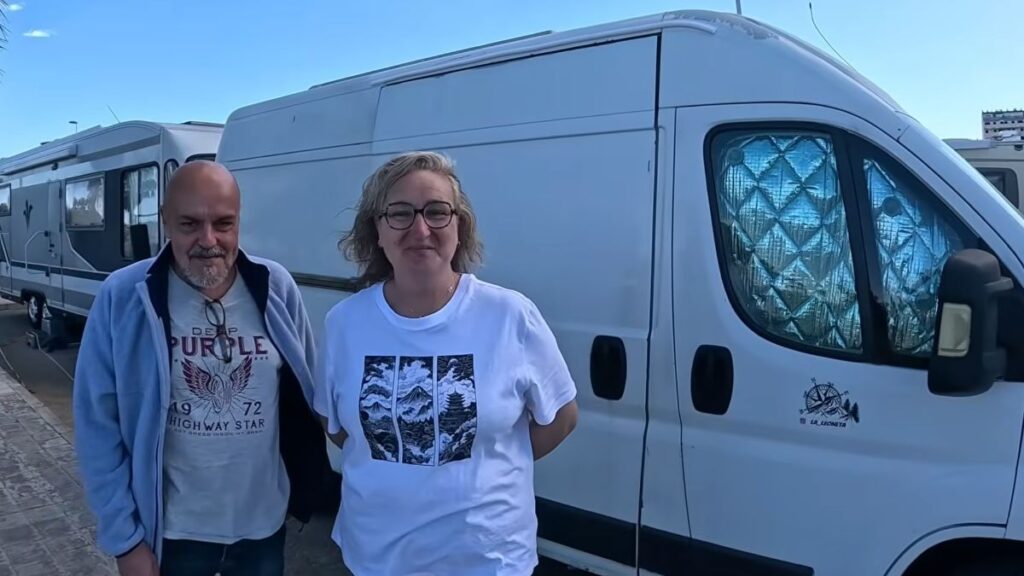
More and more people are questioning the traditional lifestyle marked by stress, rush and fixed expenses. While the price of rent continues to rise and supplies increase the monthly bill, Juanma and Tony made a radical decision: leave their previous life and move to a camper van of just 5 square meters.
“Living in a van you certainly save money,” they say in an interview on Arnau Serrado’s YouTube channel. “We use two bottles of butane a year,” they explain. A figure that, compared to the usual consumption of a traditional home, makes a considerable difference.
The couple has been living full-time in their motorhome for almost four years, which they have named “La Leoneta”. Before, they explain, they had “a life of the everyday, the common. Stress, stress, stress and you didn’t get anywhere.” Both suffer from chronic illnesses, fibromyalgia in Tony’s case and diabetes in Juanma’s. “Because we have changed, by removing stress, we have greatly improved our daily lives,” they maintain that the change has benefited them.
An “enlightenment” that changed his life
The idea came almost by chance. During a getaway to Panticosa, they saw an esplanade full of “camper” style vans. “We looked at each other like that and it was like an enlightenment. We said: ‘Oh man, this is what I want.'”
What started as an alternative for weekend getaways ended up becoming a life project. They bought a van for 8,000 euros, although as soon as they bought it they had to face a major breakdown. “We ran out of change and had to pay 3,000 euros to put in new change,” they explain.
Still, they went ahead and camped the vehicle practically by hand. “Everything else is done with a saw,” they say. It was not easy: “We argued every day,” they admit with a laugh, remembering the construction process.
How to live on 5 m²
The motorhome is adapted to your needs. They did not want a fixed shower to gain space and designed a convertible bed that makes it easier for them to rest. “We didn’t want the bed fixed because of my fibro problem,” explains Tony.
One of the most frequently asked questions is how they shower. The solution is simple but effective: an 80-centimeter folding pool, a curtain attached with magnets and a water bag with a USB rechargeable pump. For the bathroom they use a 21 liter pot that they use as a dry bathroom.
As for energy, they have a 200Ah lithium battery and a 400W solar panel. “We have more than enough,” they say. The system allows them to have electricity without paying monthly bills. “You don’t pay for water, you don’t pay for electricity,” he summarizes.
The heating works with diesel and consumption is low. “Spend very little,” they explain. The savings, as they defend, are evident compared to a conventional home where rent or mortgage, supplies and community would have to be assumed.
Live without stress (and without knowing what day it is)
Beyond the financial savings, they highlight the change in their quality of life. “I wouldn’t return to the world for anything,” Tony states emphatically. For her, living in an apartment would mean feeling “locked in,” even if it is bigger than her motorhome.
Now they spend the day outdoors, walking and in contact with nature. “I don’t know what day it is,” they confess. This disconnection from the work calendar is, for them, a sign that they have left constant stress behind.
They also travel accompanied by their two cats, who are an essential part of their life on wheels. And although they have experienced some scares, such as when someone tried to open the door for them while they were sleeping in an area, they assure that the overall experience has been positive and that the atmosphere between travelers is one of mutual support.
Although they do not rule out continuing in the motorhome for much longer, they dream of taking one more step towards self-sufficiency. “We have the illusion of having a little piece of land or a little house in the countryside,” they say. The idea is to grow your own food and live even more connected to nature.
Meanwhile, they defend their decision and encourage others to lose their fear. “Don’t be afraid,” they advise. For them, life is summed up in “trial and error.” And, after four years in 5 square meters, they are clear: the change was worth it.