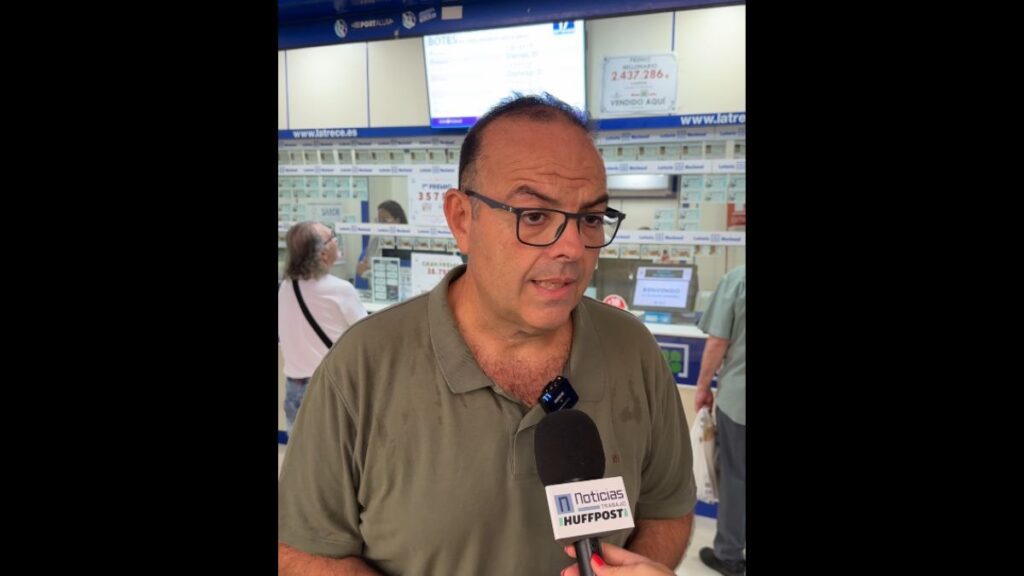
The image of the lottery administrations as stable and profitable businesses is far from the reality that the majority of those who run them face. Although selling tenths of the Christmas draw and other games may seem synonymous with obtaining great benefits, the sector has been dragging frozen commissions for years, the impossibility of paying awards in the window greater than 2,000 euros and margins that leave only a few cents for each tenth sold.
He explains Jesús Ibáñez, head of Administration number 13 of Almeríaone of the most recognized in the province, in an interview for Newsstrobajo. In his case, which began in the world of the lottery by vocation and after overcoming a public tender 27 years ago, he says that the sector has changed little since then. The State continues to hold large amounts of the amount of each tenth, while the profit margin for administrators has barely varied.
You may be interested
An entrepreneur wins 117,000 euros in the lottery and decides to distribute the prize with their employees: they will receive 1,170 euros each

A woman buys a lottery ticket, she thinks having won 10,000 euros and it turns out that she has won one million euros
Denounces the low commission that the lottery takes for each tenth
In the case of the Christmas Lottery, the most popular among the citizenship, the commission is just “90 cents of each tenth”, an amount that, according to Jesus, forces to sell “many tenths to have a really dignified commission to face the expenses involved in an administration,” he says, referring to fixed, personnel, rental or security expenses.

On the other hand, he details that “the Treasury would take about 19.10 euros of each tenth”, and recognizes that, although in most cases these funds are destined for social projects, “for the administration of lotteries and the clamor of all administrations, it is a fairly small percentage, since many years ago the commission has not been uploaded,” denounces the lotter.
“You have to be 70,000 euros of commission to cover expenses”
However, territorial inequality is evident. While the administrations located in large capitals can reach high sales volumes, this situation directly has a direct impact on the viability of many lottery administrations, especially those found in small or large flow of tourists.
Jesus, aware of the difficulty of generating large volume of sale for these businesses, according to their calculations, to cover the basic expenses without employees, “minimal that of commission is about 60,000 or 70,000 euros”, a figure that can be considerably reduced in case it is necessary to hire personnel or deal with a high rental, which is normal in a lottery administration.
Thefts, the main risk of a lottery administration
Beyond business profitability, economic risk is a constant concern for lottery. According to Jesus, “the main fear we have in the lottery administrations is always a robbery”, either by physical route, through assaults on the office itself, or by means of defaults related to the delegate sale of tenths.
In many cases, lottery deposit confidence in associations, sports equipment or brotherhoods, to whom they give lottery for sale in exchange for being paid before the draw. However, he acknowledges that unforeseen situations may occur. “It may happen that those who have sold these numbers have spent money on something else and then when paying they do not have the capital that is necessary to pay the debt,” he says, explaining that, ultimately, the responsibility always falls on the administration.
“Lottery with whom the commitment contract is with you. You have to have the money or tenths to return. If the money does not have it, you have to pay it.”
Is it worth opening a lottery administration?
In his case, Jesus acknowledges that his situation has improved since he left behind an administration located in a small core with strong seasonality. “I can cry with one eye because I am one of the province of Almería in a matter of sales,” he says, although he points out that luck has accompanied him. “The month we do not give a prize is rare … something that encourages the public to visit us,” he adds.
In spite of everything and that profitability will depend on each administration, Jesus defends the most rewarding part of the trade. And although it is not a business to use, it ensures that “you dedicate yourself to distribute illusion, to distribute awards, and in the end to share their happiness with people.”