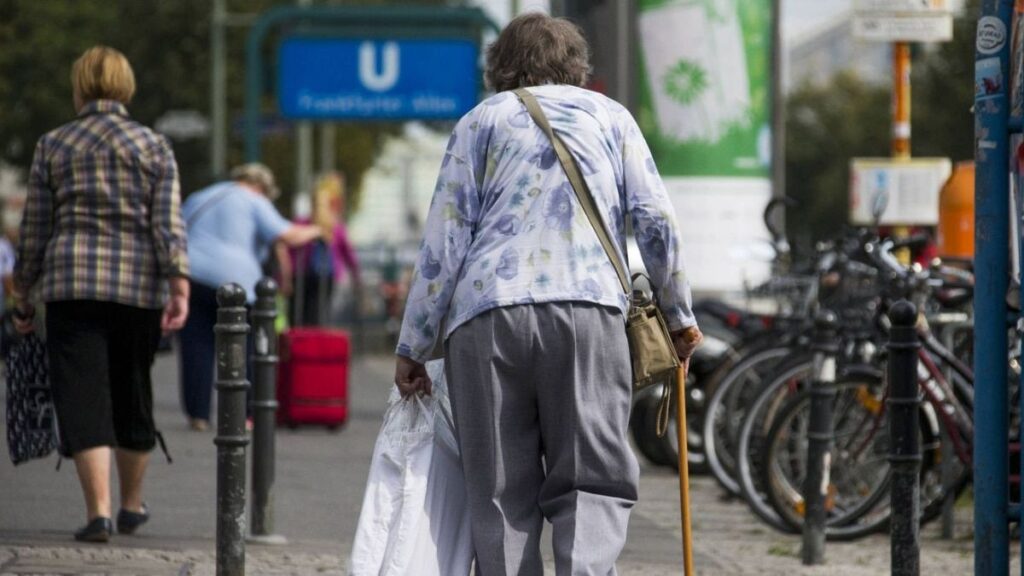
“I am available and ready to work while the body endures.” The phrase could belong to any septuagenarian who, after retiring a few years ago, decides to return to work part -time. In Germany that profile is not anecdotal, since it is a growing trend that the Executive himself wants to accelerate to sustain a pension system tensioning from demography and an economy that chains weakness.
According to the statistical office (DESTIATES), In 2024 Germany broke employment record with 46.1 million employed, despite the slowdown of the labor market since mid -2022. The key to the endurance is due to more immigration and more participation of the elderly.
You may be interested
Retirees explode against Social Security against Europe: “After having contributed 40, 45 or 47 years they submit to reducing coefficients that apply for a lifetime”

The European Central Bank recommends having cash at home to endure at least 72 hours for emergencies such as the blackout
The 67 and more will be the new retirement age
This is a tendency that looks more and more, since more and more German prolongs their working life beyond the Ordinary Age. Between 2020 and 2023, those occupied from 63 to 67 years passed from 1.31 to 1.67 million, a +26%. And 13% of those who already charge a pension between 65 and 74 years continue to work. It is not always due to economic necessity, since an important part does so for “feeling useful” or maintaining routine and relationships, although four of every ten older employed depend mainly on their salary.
The legal retirement age continues its rise gradual path and will reach 67 years in 2031 (in Spain will be in 2027). It is the great silent sustainability lever that has been applied for more than a decade.
In parallel, the great reform of this legislature (the so -called RENTENPAKET II) protects by law the level of the pension in 48% of the average salary at least until 2039 and creates a capitalization fund (“generational capital”) to soften the future effort via financial returns. The measure aspires to give certainty to pensioners, but implies greater medium -term costs.
Germany asks to work more and for a longer time
With Friedrich Merz already in the Foreign Ministry since May, the message has hardened, since tax and labor incentives so that whoever “can and wants” delay retirement and remains active. The Government has approved measures to reward the voluntary delay of the pension (something similar to what happens in Spain with the delayed retirement) and raise the appeal to continue on staff, in a country with labor deficit and a workforce that will be reduced with the massive output of the Baby Boom.
The Bundesbank and the OECD ask to go further and seek to link the age of life expectancy and review incentives of early retirement. They warn that patches to retain the elderly are not enough if discouragement or “penalizations” are not corrected and the quotes are not expanded.
Do pensions in Germany give themselves?
Germany guarantees by law that 48% “level” of the public pension (relationship between the standard pension and the average salary). International comparison, OECD data places Germany in the middle-low part of the table in a net replacement rate for a full career worker: the public pension replaces around the middle of the last net salary, below more generous countries and above the most austere. Hence, many retirees seek to complement with employment or occupational/private plans.
The aging pushes the expense, since the contribution of the State to the Pension Box is the largest chapter of the federal budget (in the environment of 121,000 million in 2025), and even so the Executive has planned adjustments of the state subsidy in the coming years to square accounts, which will predictably accelerate future increases in quotes. The IMF estimates that the expense in pensions and health will continue to increase in the next five years and require fiscal margins or reforms.
“We want who can and want, work more time.” The slogan is clear, but not all sectors are the same. The most specialized economists explain that taking the effective age at 70 (as some pose) helps to the budget but hits physical trades and raises the risk of long -term unemployment between 60 and 70 years if there is no recycling and adaptations in positions and days. Thus, public policy will have to balance incentives with protections for punished trajectories.