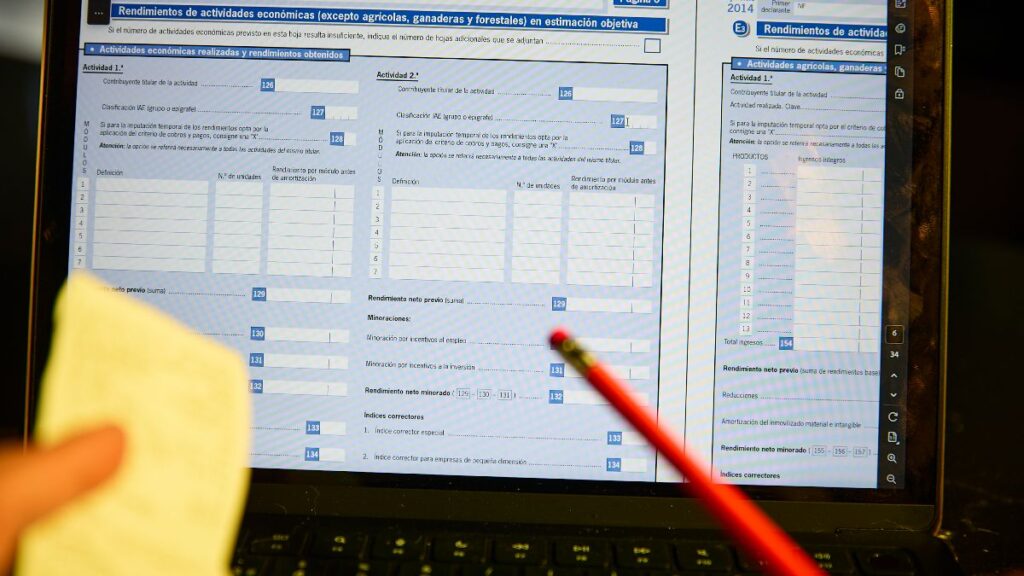


Every spring, thousands of tax drafts are accepted untouched. There are deductions that the taxpayer must activate by hand. The contribution to the spouse’s pension plan, regulated in article 51.7 of Personal Income Tax Law 35/2006, is one of the most left empty in households with a single payer. In the 2026 campaign, corresponding to the 2025 financial year, the limit and requirements continue to be those set by Law 11/2020.
Article 51.7 of the Personal Income Tax Law authorizes the taxpayer to reduce in his tax base the contributions made to a pension plan in the name of the spouse, up to a maximum of 1,000 euros per year, provided that the receiving spouse obtains net income from work or economic activities of less than 8,000 euros per year.

Emilio Baena, former Treasury worker: “People imagine that there is someone reviewing case by case, looking for errors. But the Treasury does not look for fraud, it looks for inconsistencies”

The Treasury fines a 97-year-old woman 1,000 euros for not giving “priority to her tax obligations” after the death of her husband
The rule speaks of net returns, not gross income. That is, in couples in which one works with an average salary and the other is unemployed, receives a low pension, does not work or has irregular income below that threshold, the active spouse can contribute up to 1,000 euros to the other’s plan and deduct it from their own tax base. Contributions made under these conditions are not subject to Inheritance and Donation Tax.
How to apply it in the declaration
The contribution must be made before December 31 of the fiscal year to be declared. The plan managing entity issues the corresponding certificate, and this data is usually automatically loaded into the following year’s draft through form 345 that the managers send to the AEAT.
In the 2026 campaign, corresponding to the 2025 financial year, the contribution to the spouse’s plan is recorded in box 469 of form 100, within the section on Reductions for contributions to social security systems. The contribution to the own plan appears in box 465. As the numbering is reviewed each year, it is advisable to contrast it with the Practical Income Manual published by the Tax Agency before validating the draft. The program opens a specific window for the spouse’s block in which the amount is entered and it is confirmed that the beneficiary does not exceed the threshold of 8,000 euros.
The reduction is always applied to the owner who made the contribution, not to the beneficiary spouse.
What happens if the limit is exceeded
If in any fiscal year the contribution exceeds the reducible limit, the excess is not lost, but can be carried over to the following five fiscal years. The pending amounts derived from contributions in favor of the spouse are reflected in box 437, and those from own contributions in box 463. This mechanism, regulated in article 52 of the Personal Income Tax Law, allows taking advantage of the tax advantage even if in a specific year there is not enough tax base to absorb it.

What savings does it generate?
For a taxpayer with a marginal rate of 24%, those 1,000 euros contributed to the spouse’s plan translate into 240 euros of lower net personal income tax payments. With a marginal rate of 30%, the tax savings rise to 300 euros, and with a rate of 37% it reaches 370 euros. The contribution is still marital money, it simply changes pockets, and builds private pension rights in the name of the spouse without relevant income.
It is worth keeping in mind that the future redemption of the plan will be taxed for the holder spouse as income from work, being integrated into the general personal income tax base for the year in which it is collected. Typical planning recommends deferring surrender to the year in which the spouse has the lowest overall basis, typically after retirement.
Own plan compatibility
The reduction is compatible with the contribution to the taxpayer’s own individual pension plan, which has a separate limit of 1,500 euros per year according to article 52 of the Personal Income Tax Law, extendable up to 8,500 euros if the difference comes from business contributions or contributions to simplified employment plans.
This limit of 1,500 euros of the own plan is also subject to a second limit: the reduction cannot exceed 30% of the net income from work and economic activities for the year, and the lower of the two amounts is always applied. The limit of 1,000 euros for contributions to the spouse is independent of this calculation and is added to the previous one.
That is, the same taxpayer can reduce their tax base by up to 2,500 euros per year by combining their own plan (1,500 euros) and the contribution to the spouse’s plan (1,000 euros), as long as the requirements of each limit are met.