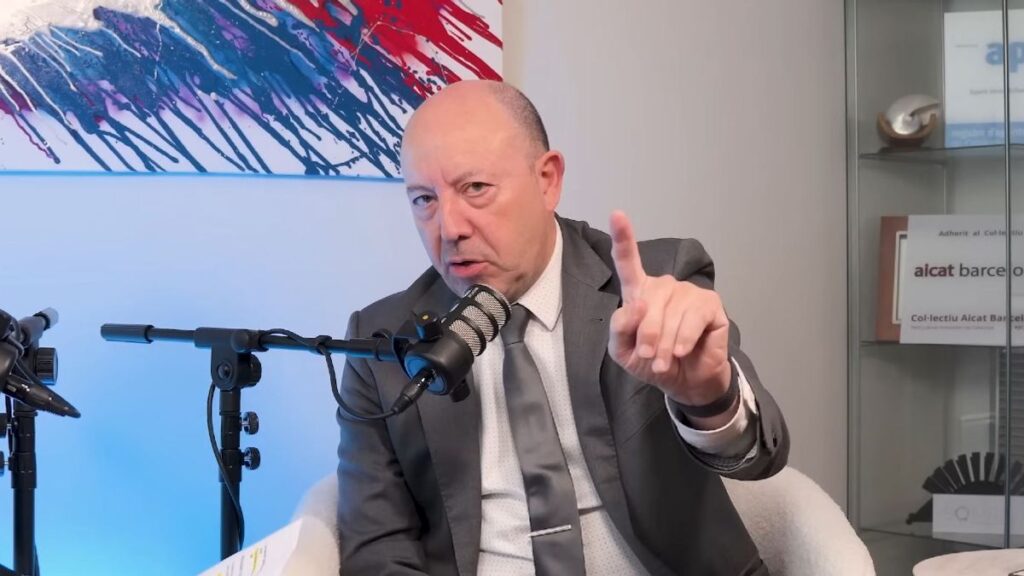
Housing is one of the biggest headaches for Spaniards in recent times and as with all problems that affect society, there are many losers and a few winners. Those few winners are those who are knowing how to invest in housing, even with few resources. One of the alternatives that are becoming fashionable for those who fight against high housing prices and invest, even if they have little money, is to buy individual rooms in apartments in order to rent them out.
Some rooms go up to 100,000 euros but there are still people who buy them, due to the high rental prices and how complicated it is for many to get a mortgage. All with the idea of renting them later and making a profit. Economist Gonzalo Bernardos wanted to give his opinion on this trend, who is clear that it is a trend that can provide an “interesting return” for those who dare to do so. Despite this, it also has its obstacles, as explained in an intervention for the program Better late, on La Sexta.
Buying rooms could be “dangerous”
The latest trend that is spreading in the real estate market has surprised many specialists. It consists of selling rooms within an existing home with an owner, instead of renting them, with the aim of increasing the profitability of the property. As they taught in the program Better late, it is now possible to find rooms in large cities like Madrid with purchase prices that can easily reach 100,000 euros.
For Gonzalo Bernardos, this practice, to say the least, is “misleading advertising.” He expressed this clearly during his intervention on the La Sexta program when analyzing what is really behind this model. In his opinion, this is a “dangerous” formula for those thinking about buying a room.
“You don’t really buy a room, but a part of the apartment. You can buy 20%, 30%, 40%… but it is not a room. You certainly don’t have a room for yourself,” the economist and professor at the University of Barcelona began by explaining. According to Bernardos, these types of operations are aimed mainly at “people who speculate in the real estate market.” That is to say, he considers that it may be profitable for speculative profiles, but not for ordinary citizens.
The impressive profitability of selling rooms in apartments
“The business here is that where there are three rooms, I put four up for sale. How? Liquidating the dining room. I only leave the kitchen. If that apartment, for example, is worth 250,000 euros, since they are going to buy it in parts, I raise it to 320,000 because 80,000 euros per room can be paid by many people, especially young people or people who do not have much purchasing power and who, therefore, would not be able to afford to buy a home,” Gonzalo Bernardos continued to explain when warning about the risks of purchasing a room.
However, the expert insists that not everything is as positive as it may seem. The economist maintains a firm position regarding this business model. “It will be very difficult for them to sell, because I don’t think there are many people willing to buy a percentage of a flat, especially when 40%, 50% or 60% is owned by people you completely don’t know and who can be problematic,” he points out when referring to the complications that selling this type of shares in the real estate market can have.
As Gonzalo Bernardos explains, buying a bedroom in a home actually means acquiring a percentage of the property. Even so, he considers that it is an operation that, in many cases, “is very expensive.” Of course, he recognizes that it can be profitable if the investment works. “I buy a room for 80,000 and rent the room monthly for 700 euros. It is a bargain compared to a traditional home, which has a net profitability of 4% or 5%,” he explains. From this perspective, he admits that profitability “is very interesting”, although he insists that it is not a recommended option in all cases.
The great problem of access to housing
The trend that Gonzalo Bernardos refers to has a clear explanation. Access to housing at affordable prices continues to be one of the big problems in Spain and worries both young people and adults.
“We have a million young people with poor financial conditions and another million and a half with a stable job, who sooner or later will want to buy a home. The big problem is that the supply does not accompany this panorama,” said the economist and professor at the University of Barcelona in the Finect Talk podcast.
Added to this scenario is the employment situation of young people in Spain, which further complicates access to housing.