Spain is experiencing one of its worst moments in the countryside. The agricultural sector represents 2.5% of the GDP and employs 3.6% of the active population, but more than half a million people cannot make a living from it.
The prices paid by companies and supermarkets are minimal, and many farmers throw away or give away their product because it is not profitable to sell it below the cost of production.
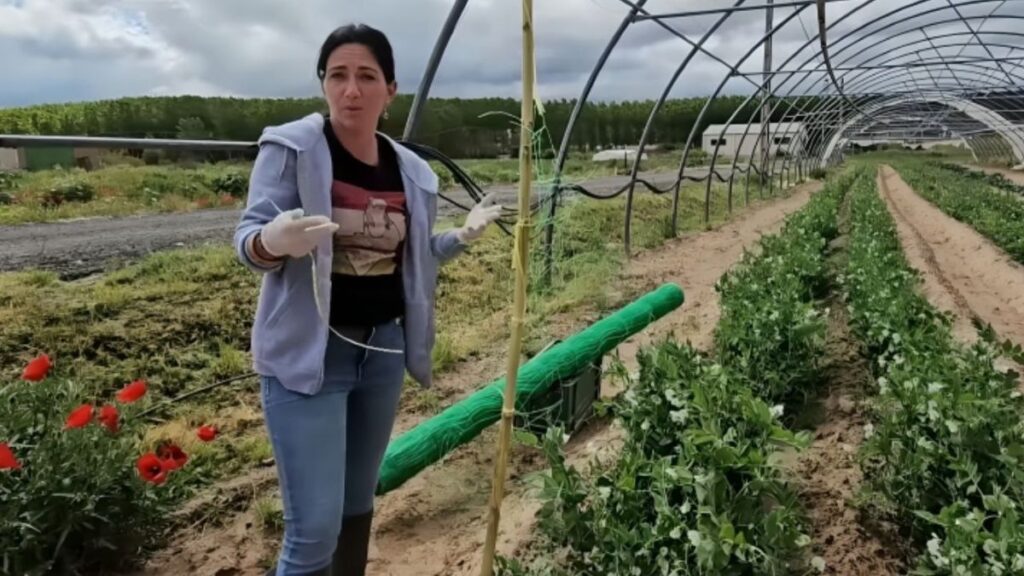
Clara Sarramián, a self-employed farmer in Logroño, has been in the business for four years and a few months. “Last year, when trying to sell it… in the end you have a lot of kilos and they wanted to pay me half the price of the previous year. I preferred to throw it away because, in the end, if we all go through the hoop, what we are going to achieve is going against us,” he says in an interview with Jaime Gumiel.
This Spaniard’s love for the countryside comes from her family: grandparents, parents, cousins… “At the end my mother retired and I was angry to leave this. I had enough resources to be able to continue the business,” she says.
Hers is conventional agriculture, where she assures that she prefers to work alone: ”I continue the same as what my parents did. I work alone and doing organic farming would be much more work for me.”
“I sell it for 80 cents and they buy it for €3.5”
Despite what many may think, being a farmer is not easy. Although in winter Clara assures that “I work fewer hours,” in summer, the days are usually very long and the days are intense “with minimal sleep.” During these times, the woman indicates that she can work up to 16 hours.
“The physical thing is very hard, but you end up getting used to it. Mentally it is the worst, perhaps because of the extreme weather, the hailstorms and all that,” he adds. Furthermore, unfair competition from outside the European Union is also one of the big problems it faces. “It is impossible to compete with those prices. People say they value the national product, but in the end they look at their pockets.”
According to data from the Ministry of Agriculture, production costs (energy, fertilizers or feed) have remained at critical levels, making profitability difficult. As if this were not enough, the gap between the price of origin and destination continues to be one of the biggest distortions in the market, with differences that in fresh products can exceed 400%, according to the IPOD index.
Despite the Food Chain Law, which prohibits selling at a loss, the concentration of distribution puts pressure on the farmer’s margins. As Clara points out, she sold her products to distributors and supermarkets: “Hopefully I will have sold it for about 80 cents or 1 euro at most. Then, in the store it can be 3 and a half euros. A lot of money goes to intermediaries and the product loses freshness in the chambers. Economically, before I was losing money.”
The truth is that Clara feels valued by society, but not by the State, since “it seems like they want to get us out of the way.” Although he has thought about leaving many times, “I will continue to have my little garden at home and I will have to work as hard as I can.”