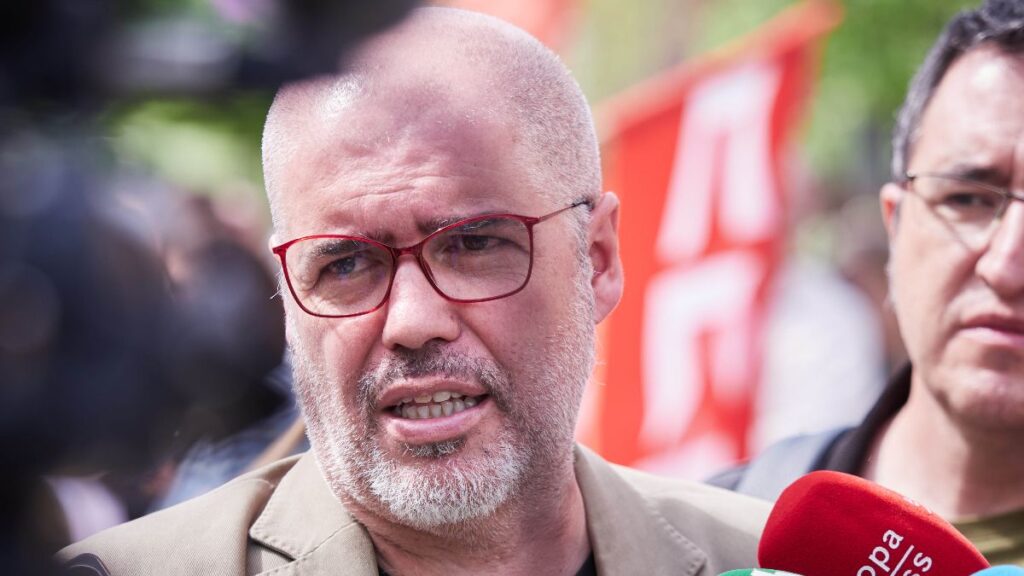
The general secretary of the Workers’ Commissions (CCOO), Unai Sordo, has demanded that wage and social policies be immediately reinforced to deal with inflation with proposals as clear as that of a new aid of 300 euros for households with less income. “Prices will continue to increase and this requires an increase in salaries to prevent people from paying the price again,” he said.
Sordo has spoken at one of the assemblies that the union is holding throughout Spain to analyze the current political and economic context and with which between 20,000 and 25,000 delegates will be mobilized. The priorities, as Europa Press points out, are the improvement of salaries, access to housing and labor conciliation measures.
He has highlighted that geopolitical tensions, particularly the war in the Middle East, are causing a rise in prices, which is increasingly reminiscent of the inflationary crisis experienced after the Russian invasion of Ukraine. “Then companies were able to safeguard their margins but salaries did not rise enough and the same cannot happen now.”
A “negative tax” that provides aid to families with less income
CCOO has proposed combining collective bargaining with public measures such as the implementation of what it called a “negative tax” on personal income tax that would allow 300 euros to be transferred to some ten million low-income families. The estimated cost is around 3,000 million euros and would be “affordable and necessary” to cushion the impact of inflation.
This diagnosis is the response to a problem of “deterioration” that is sustained over time. “There are 11 million salaried people with stagnant salaries,” he pointed out, clarifying that they face “the increase in the costs of the basic basket and the increase in the price of housing, which is unbearable.”
“No one should pay more than 30% of their salary on housing”
Access to housing is the second axis of the demands, since Unai Sordo has requested an agreement between administrations that indicates that no household has to allocate more than 30% of its income to this expense. To achieve this, it has proposed measures such as the construction of millions of affordable homes in a decade, limitations on rentals in stressed areas or mobilizing empty homes.
According to the data presented, there are 700,000 unoccupied homes in municipalities with more than 100,000 inhabitants that should be penalized fiscally if they remain closed for speculation. He has also demanded that there be more public investment in housing reaching 1% of GDP, more than double the current level.
He has asked that the Autonomous Communities in which the PP governs get involved since “they cannot put themselves in profile” since the solution is “institutional.”
Denounce the “demonization” of those who cannot pay the rent
On the political level, the union leader has criticized the possible non-validation of the rental extension decree in Congress, and has described the situation as “unpresentable.” He denounces the “demonization” of people who have difficulties paying their rent.
“It gives the impression that those who cannot pay are little less than criminals,” he highlighted, criticizing what is an “antidemocratic drift” in the public debate on housing.