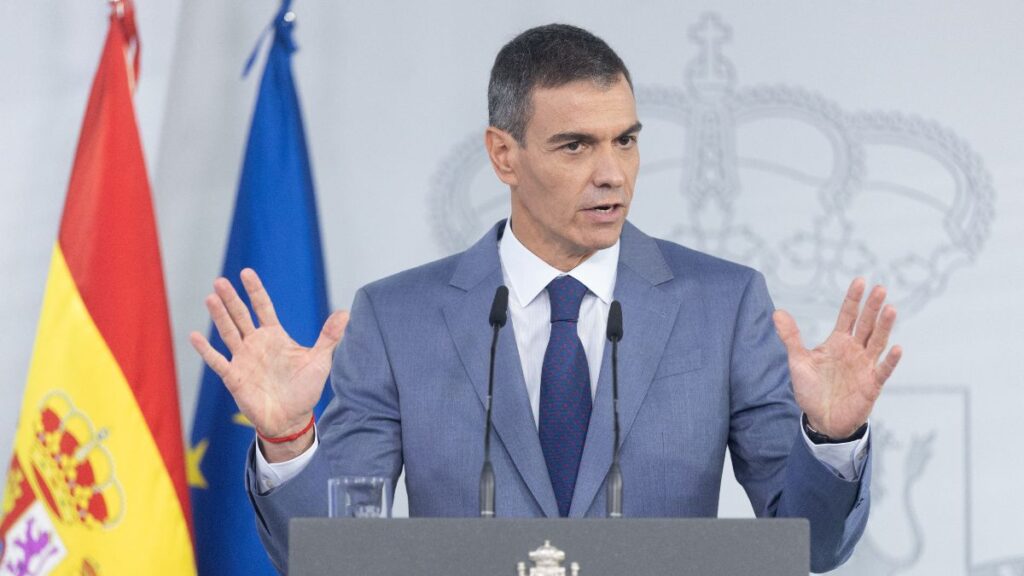
Pedro Sánchez plans the last days of the campaign appealing to the massive vote for the PSOE, focusing on aspects as important as aid (he wants automate the Minimum Living Income so that it is granted ex officio‘) or measures such as extension of leave to 10 days for the death of a family member. But, these measures, and those that have been previously revalidated, affect the State’s coffers and now the Executive faces a possible sanction from the European Union (EU) for excessive deficit in 2027, once it is confirmed that the growth of public spending has increased the agreed limits to guarantee a gradual reduction of the debt.
Europe understands that Spain is going to close 2026 with a cumulative spending deviation of 0.9% of the Gross Domestic Product (GDP), which is three points more than what is allowed by European fiscal rules, which is 0.6%, and this translates into 5.1 billion euros over the margin. The warning comes once the Government is preparing to close a legislature in which the General State Budgets (PGE) have not been approved. The deficit path did not even move forward.
The General Budgets marked by fiscal rigor that never arrived
Spain has a General State Budget, yes, but they are the ones that existed in 2023, since the lack of parliamentary consensus has prevented Sánchez from carrying out new ones. Now, Brussels stands up to the socialist leader who, in a meeting between the EU and the Eastern Balkans, assured that it was urgent to approve public accounts that were social and complied with the “fiscal rigor” that characterized the Government.
But on June 17, during a control session in the Congress of Deputies, they again insisted to the president about the PGE and he responded by assuring that they would be consistent with social advances, guaranteeing an economic transformation. And after this came new promises and even a failed attempt at budgeting.
Now, a legislature focused on general elections ends, without public accounts and with fiscal forecasts that have plummeted over the last six months. In May, Brussels calculated a spending deviation of 0.45% of GDP, half of the current 0.9%. And in 2027, the forecasts have increased the difference to 1.3% of GDP, which means exceeding the margin by about 1,200 million euros.
The EC has questioned the Spanish budget management although it has explained that governing with extended accounts, which expire due to the rise in inflation, does not violate the community standard although it affects the management of public finances.
The salary increase for civil servants aggravates the public deficit
The Sánchez Government, through Minister Óscar López, announced a 4.5% increase in the salary of civil servants, a measure that will cost 4,965 million euros to public coffers. In addition, the workforce of public employees has increased in all administrations, especially in the regional ones.
And, to alleviate the economic consequences derived from the conflict in the Middle East, different measures had to be approved. The EC’s forecasts, however, do not include this latest salary increase for civil servants, since their estimates have an expiration date: November 3.
Now, they ask Spain to take measures and correct this situation with an increase in public income or with spending containment. The idea is to guarantee that the country complies with the agreed fiscal path by reducing debt.
The possible file or sanction that would be imposed from Europe does not mean that Spain has exceeded the public deficit limit of 3% of GDP, but rather that the debt is above the community threshold of 60% and that spending continues to increase, compromising the reduction.
Pedro Sánchez sends a message to thousands of retirees: “pensions are sustainable and the Reserve Fund will increase to 50 billion in 2030”
The Government extends the tax that will allow the construction of 6,000 affordable homes and the application of tax credits to 120,000 tenants
When the EC reviews these accounts again, in spring 2027, it could recommend that the file for excessive deficit be opened and that will be up to the Member States.