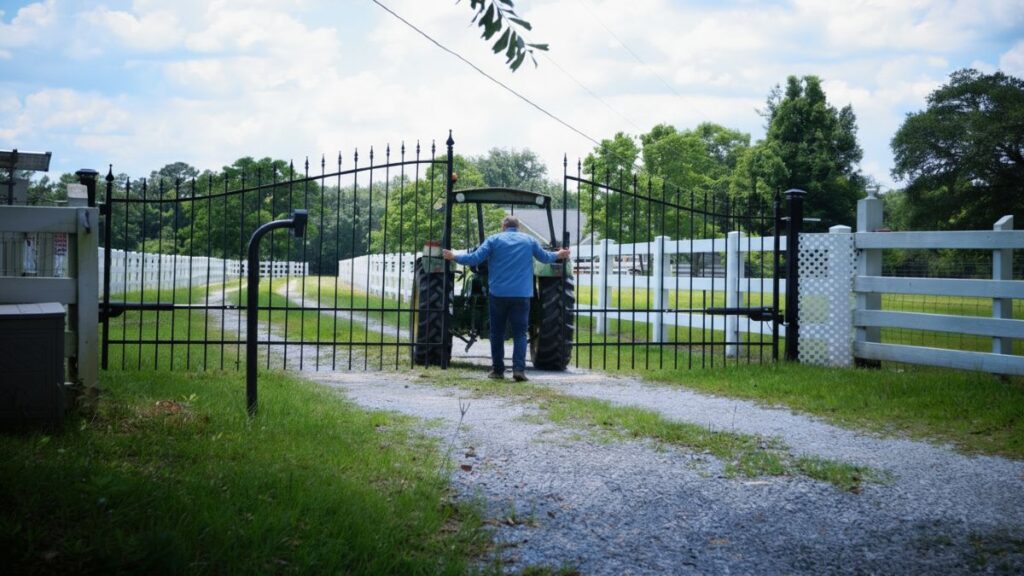
The Supreme Court has confirmed that patio owners can maintain the fences that delimit their property, even if this forces neighbors to stop their tractors and get out to open them by hand every time they need to pass. The High Court considers that this maneuver does not impede access, but rather is an acceptable nuisance that the neighbors must assume compared to the owner’s right to close his property. However, justice does require the immediate removal of the camera and alarm installed, understanding that these devices represent a deterrent control of passage and a “disquiet” that illegally disturbs the uso of the passage “from time immemorial.”
According to the ruling of January 28, 2026, the owners of the patio installed fences that forced neighbors to stop their vehicles and open them manually to be able to pass through and, in addition, they installed an alarm system and a video surveillance camera that permanently recorded the passage area. On at least one occasion the Civil Guard came after the alarm was activated, to identify the neighbors while they were exercising their right of way, generating a climate of intimidation and control that those affected denounced as an intolerable disturbance of their possession.
Both the Court of First Instance No. 1 of Torrelaguna and the Provincial Court of Madrid dismissed the lawsuit considering that access was not physically prevented. The court ruled that having to get off the tractor to open the fences was a “mere nuisance,” while the Court confirmed that the camera and alarm were lawful measures to protect private property.
The fence is just a nuisance, but the camera and alarm have an intimidating effect
The Supreme Court disagrees with the previous criterion only with respect to electronic surveillance, considering that it cannot be classified as a simple irrelevant nuisance. It bases its decision on article 446 of the Civil Code, which establishes that every possessor has the right to be respected and, if he is concerned, he must be protected by the means that the procedural laws establish, in relation to article 250.1.4º of the Law of Civil Procedure on the summary protection of possession.
The High Court considers that the installation of fences is legal, based on article 388 of the Civil Code, which authorizes all owners to close their properties. As it is a low fence without a lock, which could be opened freely, it does not impede passage; It only represents an inconvenience for the neighbors who have to get off the tractor to open it and be able to pass through, something that is classified as a mere annoyance that does not amount to a legal disturbance.
Regarding electronic surveillance, after the application of the doctrine on the protection of the status quo and social peace, it is considered, according to the Supreme Court, as a “turbation” with sufficient magnitude to deserve judicial protection. And the constant surveillance of movements and the intimidating effect of the alarm imply a deterrent control that worries the possession of the pass.
For all these reasons, the owners are allowed to keep the fence, even if it inconveniences the neighbors when they pass by with the tractor, but they will have to remove the alarm and the camera.