
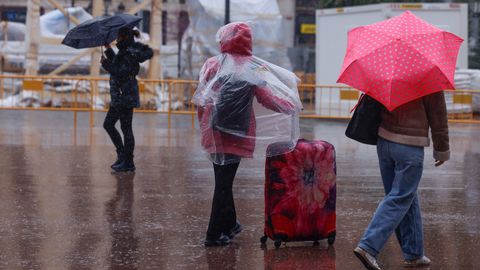
The weather in the Peninsula and the Balearic Islands is experiencing its last winter scenes today, Monday, April 13, under the influence of a trough that retreats towards the Mediterranean. However, the State Meteorological Agency (AEMET) maintains the orange alert activated due to significant risks in the northeast and the Balearic archipelago.
In the southern pre-coastal area of Tarragona and Ampurdán (Girona), gusts of northwesterly winds that reach 90 km/h are recorded, while in Menorca the sea storm is especially severe with waves that can reach 5 meters high.
The AEMET activates the yellow alert throughout the Community of Madrid: strong storms and hail are expected during the next few hours

Spanish households are asked to close windows and blinds this Thursday due to orange notices in 3 regions
This dangerous situation extends with yellow warnings to the Valencian Community, where the interior of Castellón also supports gusts of 90 km/h. The thermal sensation is much lower than usual for these dates due to the intensification of the gale in the Ebro Valley and the Tramuntana in the northeast, which maintains the unpleasant atmosphere in provinces such as Teruel and Zaragoza with gusts of 70 km/h.
Rain and snow in the north
Throughout the day, rainfall is concentrated in ten autonomous communities, being more persistent on the Cantabrian slope, Navarra and the Pyrenees.
In these areas, the snow level is still between 900 and 1,300 meters, which represents a radical contrast to the haze that dominated the skies just a few days ago. “Precipitation will rapidly subside this Monday towards the Mediterranean” as the polar air mass begins to be displaced by an anticyclonic ridge, as Meteored points out.
Furthermore, in points on the coast of the Basque Country and Alicante, accumulations of up to 30 l/m2 are expected before the front definitively leaves Spain.
For its part, in the Canary Islands the trade winds will continue to blow with strong gusts, maintaining an altered maritime situation on the northern and northeastern coasts of the most mountainous islands.
Radical turnaround in 48 hours
Starting tomorrow, Tuesday, the entry of a powerful subtropical ridge will cause a widespread and pronounced thermal rise. According to meteorological models, the anticyclone will settle strongly over Spain, erasing any trace of instability in 95% of the country. This change of scenery will cause the thermometers to recover day after day until they reach fully spring and even summer values.
Forecasts indicate that Friday will be the peak day of this heat episode, with temperatures that “could reach or exceed 30 degrees” in the Guadalquivir valley.
Similar records are also expected in the Guadiana and the Tagus valley. Despite this stable environment, it is not ruled out that some evolving storms will appear in mountain areas over the weekend, a typical spring phenomenon that will provide a counterpoint to a week of mostly clear skies.