
The Superior Court of Justice of Andalusia has given the reason to Social Security to deny the widowhood pension to a woman who claimed the benefit after the death of her ex -husband. The National Social Security Institute denied it, since it did not comply with the minimum contribution period by not computing as quoted the days that was on a temporary disability with no right to unemployment benefit. The Court explained that the law does not allow those periods to be contained to comply with the contribution requirements.
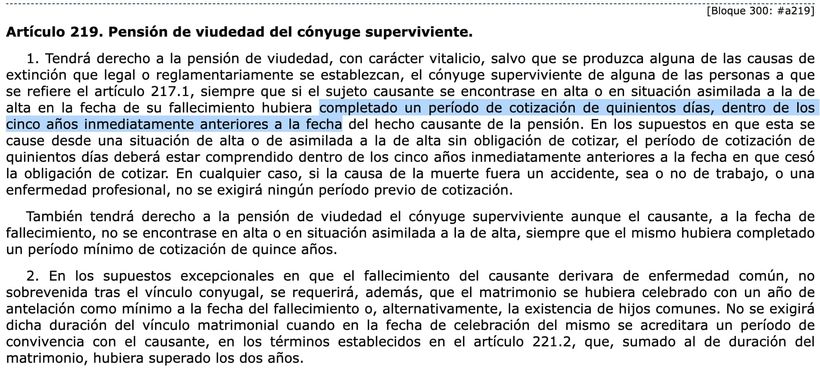
The case begins on March 22, 2020, date on which Antonio dies, ex -husband of Clara, with whom she had been married since 1999 and where, as a result of this relationship, they had children before divorcing in 2010. After the death, Clara requested the widowhood pension to social security, but was denied when she did not meet the minimum price period of 500 days in the five years before the death It was beneficiary of a compensatory pension after divorce, required in these cases.
You may be interested
A woman charges the widowhood pension after marrying in Morocco with a man still linked to another wife and social security claims 15,959.74 euros: the supreme rejects

A man charges the widow’s pension while he was married to another woman and must now return 29,075.18 euros to social security: the supreme supports him
Despite this, the woman returned to submit a new application in April 2020, accompanying documentation related to a restraining order issued in 2019 against their ex -husband for ill -treatment. In spite of this, Social Security denied it again explaining the same reason, which was not reached by the minimum contribution lack, even applying the doctrine of “parenthesis” due to illness.
Given this refusal, Clara decided to file a claim, but she was also dismissed, so and as the only option was to go to court and challenge the social security decision.
The periods of temporary disability without the right to the benefit do not comput for the widowhood pension
In the first view, the Social Court number 3 of Córdoba gave the reason to social security, understanding that the ex -husband of the plaintiff did not reach the 500 days of contribution required in the five years prior to his death. The widow claimed that the time in which she remained in temporary disability should be computed after the termination of her contract. For his argument, he explained that article 283.1 of the General Social Security Law (which can be consulted in this Official State Gazette) should be applied, which regulates the situation of those who continue in temporary disability once the employment relationship is completed. That is, he defended that these periods should be counted as quoted to access the benefit.
Social Security explained for its part that this time could not be taken into account, since the deceased had no right to unemployment benefit, which prevented it from considering it as quoted. For this reason, the Court gave the reason to Social Security.
Despite this, the woman was not satisfied and decided to resort to the Superior Court of Justice of Andalusia, who gave the reason to Social Security. This explained that the regulations do not protect, in an analogical way, that the days of temporary disability without unemployment after the termination of the contract can be computed as quoted, unlike other cases in which fictional contributions are recognized.
Therefore, the Superior Court of Justice of Andalusia denied the widowhood pension, so this woman runs out of it, but taking into account that she can present a appeal before the Supreme Court.