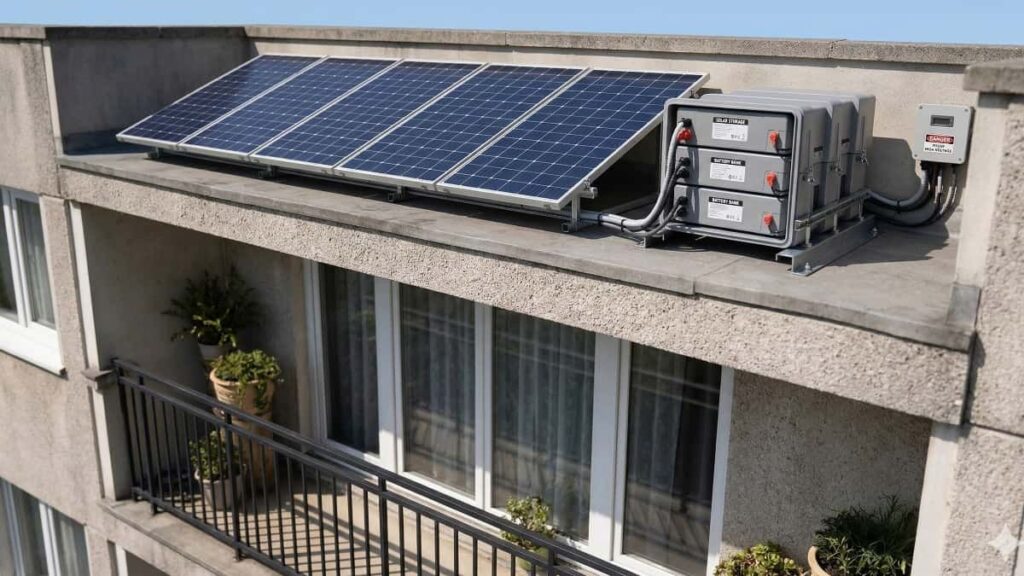
A Romanian who paid about 100 euros per month (500 lei) on his electricity bill has now reduced his bill to zero after installing photovoltaic panels and storage batteries. The case, broadcast on Romanian television Observerexplains a trend where thousands of families seek to produce their own energy to avoid volatile prices and depend less on the grid.
The protagonist of the report, Bogdan Vizonie, explains his motivation with a very contemporary domestic logic: “I wanted to be practically energy independent” and I was thinking about also electrifying the heating in the future with a heat pump, “which consumes a lot of electricity.” The solution was, therefore, to generate and store.
The key is what is known as a “prosumer”, which is the figure that allows consumption and, at the same time, injecting surpluses into the network. Vizonie explains that in his first two days as a prosumer he produced 29 kWh that he poured into the grid, in addition to covering what he consumed at home.
The boom is being noticed in the market. Observer It speaks of more than 10,000 homes per month that install photovoltaic systems with batteries and anticipates that, by the end of 2026, almost half of prosumers will have storage. It is an important nuance: the growth is no longer explained only by the panel, but by the battery.
The numbers provided by the report help to understand why. According to one installer cited, the entry point is usually a 5 kWh battery, with minimum prices “around 200 euros (1,000 lei)”, although the market is moving towards capacities of 15, 20 or 30 kWh, adjusted to the customer’s consumption.
In the standard example that handles Observera 100 m² home with a consumption of 400 kWh per month and an 8 kW photovoltaic installation would cover approximately 60% of the consumption, but the bill would be close to 40 euros (200 lei). If a 10 kWh battery is added, the coverage would rise to 90% and the bill would drop to about 10 euros (50 lei).
The cost is also on the table: the average price of a system of this type is around 8,000 euros (40,000 lei). Even so, the return argument appears again and again in the speech: “in a few years” the investment can be recovered, especially if electricity continues to become more expensive.
The public factor and the jump in scale
Expansion does not occur in a vacuum. Observer points out that, after the blocking of the Green House program last year, in 2026 it will only be possible to invest in storage systems, a shift that pushes to prioritize batteries over new plates. For installers, the “ideal” would be to return to a scheme that includes photovoltaics, although they recognize the “added value” of storage.
Romania, in addition, is growing at a rate that the report itself describes as the fastest in Europe, since nearly 300,000 homes produce their own electricity and the total installed capacity reaches 3,400 MW. Some days, he maintains Observerphotovoltaic solar becomes the country’s main source, ahead of gas and hydroelectric power. If the data is consolidated, energy independence begins to stop being an individual aspiration and become a national variable.