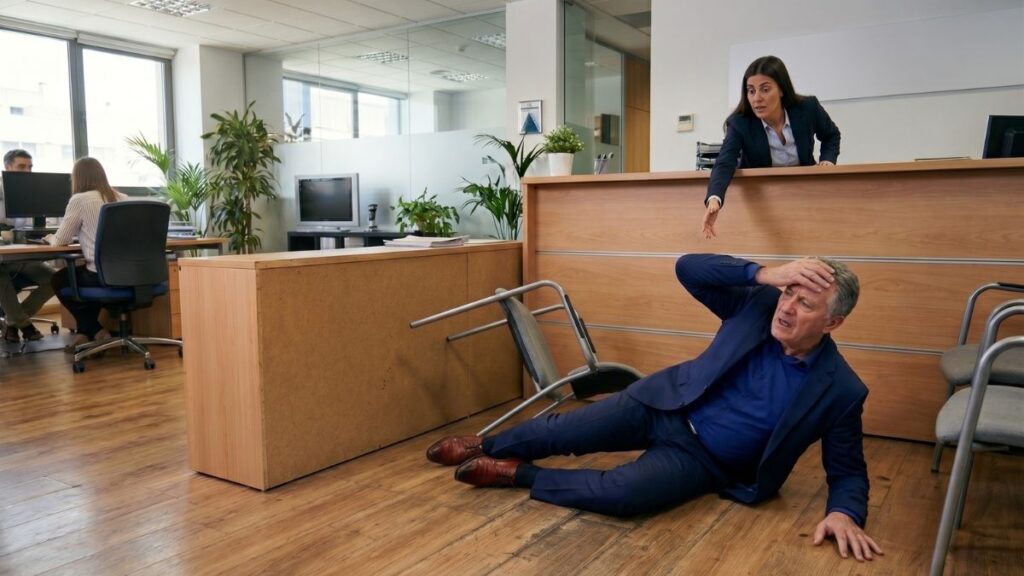


The Provincial Court of Santa Cruz de Tenerife has sentenced a company and its insurer to compensate 41,883.49 euros to a client who suffered a fall after the chair he was sitting in broke while being treated. The trial court had dismissed the lawsuit alleging misuse by the client of the chair in question, which was not enough, since the chair was broken from before.
According to the ruling SAP TF 209/2026 (which can be consulted at this link from the Judiciary), the affected person claimed compensation for damages from the plumbing company where he was treated and the responsible insurance company. The Court of First Instance number 6 of Santa Cruz de Tenerife had initially rejected his claim, understanding that the fall had occurred due to the client’s own fault. However, the Provincial Court does not share that conclusion and considers it proven that the man fell because the chair broke, without it having been proven that he misused it.

Social Security pays aid of between 57 and 115 euros per month to families with minors, even if they do not receive the Minimum Living Income

The price of electricity today, Monday, May 25, in the PVPC skyrockets and leaves 3 sections above 200 euros
It all started on September 11, 2017, when the client went to the company’s establishment to carry out some procedures. While he was sitting in a chair intended for customer service, the furniture broke and fell to the floor. The company and the insurer denied their responsibility and argued that the accident had not been sufficiently proven, in addition to pointing to possible misuse of the chair.
The first instance ruling accepted that version and dismissed the claim. The client appealed, alleging an erroneous assessment of the evidence and arguing that the company should be held accountable for not maintaining the furniture used to serve its clients in adequate condition.
The Court rejects that the fall was the client’s fault
The Provincial Court examines the evidence again and reaches a different conclusion. For the magistrates, it was proven that the actor “fell while sitting in a chair of the co-defendant company, when it broke,” without it being proven that the cause of the break was misuse on his part.
The court recognizes that there were contradictions between the witnesses. But it stands out that the only person who was present at the time of the incident was the employee who was serving the customer. Furthermore, the ruling indicates that, although the worker was later able to tell her colleagues, “laughing,” that the client had fallen because he was swinging, that story could not detract from the credibility of what was later stated in court.
The Court adds another relevant detail: the employee also stated that that same morning the chair “had caused problems.” For the court, if she was in charge of serving the clients who sat on that piece of furniture, “she could well have removed it or warned the person who was going to use it.”
This point was key to appreciating the company’s responsibility. The Court explains that it is not about automatically applying strict liability for any fall, but rather about verifying whether there was a lack of diligence in the maintenance of the facilities.
The company had to keep the chair used to serve the public in good condition.
The Provincial Court recalls that, in falls that occur in commercial establishments, liability may exist when an omission of required surveillance, maintenance, signage, care or precautionary measures is identified. In this case, the chair was intended to be used by anyone who came to the company to be served.
Therefore, although it could not be proven that the chair had previously caused problems, and even if the hypothesis that the client was rocking was accepted, the Court concludes that what is relevant is that the furniture broke. According to the ruling, “the chair, intended to be occupied by any person who went to the co-defendant company to be attended to, broke,” which shows “its poor condition or its lack of suitability for the purpose for which it was intended.”
Consequently, the Court appreciates a lack of diligence in the maintenance of the facilities intended for the attention of the public. This lack of diligence generated a risk that finally materialized in the plaintiff’s downfall, which is why the company and its insurer were declared civilly liable.
The fall made his lower back problems worse.
The ruling also analyzes the damages suffered by the client. After the fall, the victim went home driving his own vehicle, but the next day he was treated at home by a doctor due to disabling pain. He subsequently went to a neurosurgeon, who noted progressive discomfort, right sciatica, and a condition compatible with congenital or degenerative stenosis.
The Court recognizes that the client previously suffered from a lumbar pathology, but considers that the fall aggravated or decompensated this chronic process. In fact, he needed a first surgical intervention, subsequent treatments in the Pain Unit, epidural blocks and medication.
The ruling states that, in October 2018, the pain had become chronic and that the possibility of a second intervention was even foreseen, which was finally carried out in 2019 for palliative purposes. Now, the Court does not grant everything claimed, but rather sets the healing period from the accident, which occurred on September 11, 2017, until the stabilization of the consequences, on October 10, 2018, a total of 395 days.
Finally, the Provincial Court partially upholds the appeal, revokes the first instance ruling and jointly condemns Fontanería y Calor 2006 SL and Mapfre to pay the client 41,883.49 euros, plus interest. It does not impose costs in any of the instances.