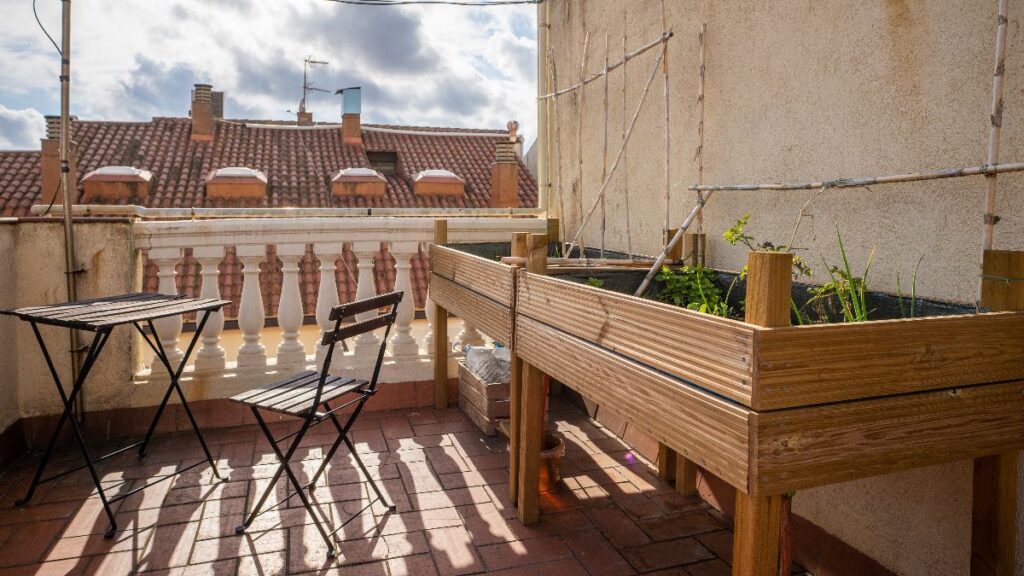
The Provincial Court of León has ruled in favor of a community of owners by determining that a neighbor cannot maintain an urban garden on his terrace for private use if this harms the safety and conservation of the building. The sentence ratifies the order to immediately remove the tomato plantation, the accumulated earth and the scrap metal that the man kept in the yard. According to the court, although the owner has exclusive use of that space, his cultivation activity exceeded legal limits by causing constant humidity which seriously damaged the roof of the garages located directly below.
According to the ruling of September 18, 2025, the garden had been installed in a precarious manner, according to photographs and testimonies, soil had been poured directly onto the tiles and polystyrene boxes were used to grow tomatoes. The constant watering of these plants, added to the poor condition of the drain (clogged by garbage and accumulated construction materials), caused the soil to absorb a excessive humidity that ended up seeping into the lower garage. This situation became dangerous, even causing vaults to fall onto parked vehicles due to the weight of the earth and water seepage.
The Court of First Instance number 1 of León determined that, since the community was suffering direct damage from the orchard, there was no other solution than the cessation of the activity.
The urban garden as a “prohibited” and harmful activity
The Provincial Court of León confirmed that the garden had to be removed because the right to use the terrace did not authorize the owner to carry out annoying or dangerous activities that went against the Horizontal Property Law (LPH) and the building’s statutes. In this sense, the court considered it proven that the cultivation of tomatoes and the accumulation of materials constituted a prohibited and harmful activity for the property according to article 7.2 of the LPH, since the structure of the property was not designed to support the weight and constant humidity generated by an urban garden of these characteristics.
Added to this violation was the failure to comply with the maintenance duty provided for in article 9.1.b of the LPH, since the owner neglected the care of the facilities by neglecting to clean the drain and allowing water leaks to directly damage common elements such as the garage floor.
Likewise, the ruling highlighted the violation of article 8 of the community statutes, which expressly prohibited occupying common elements with facilities or furniture of any kind. Since the terrace is the roof of the garages, its use as an area for cultivation and installation of construction materials was a direct contravention of this internal regulation that the neighbor had to comply with.
For all these reasons, the court ruled that respect for common property should prevail over the interest of the owner, forcing him to remove all the plants and materials and leave the community’s gas pipes free.
However, the sentence was not final and an appeal could be filed against it.