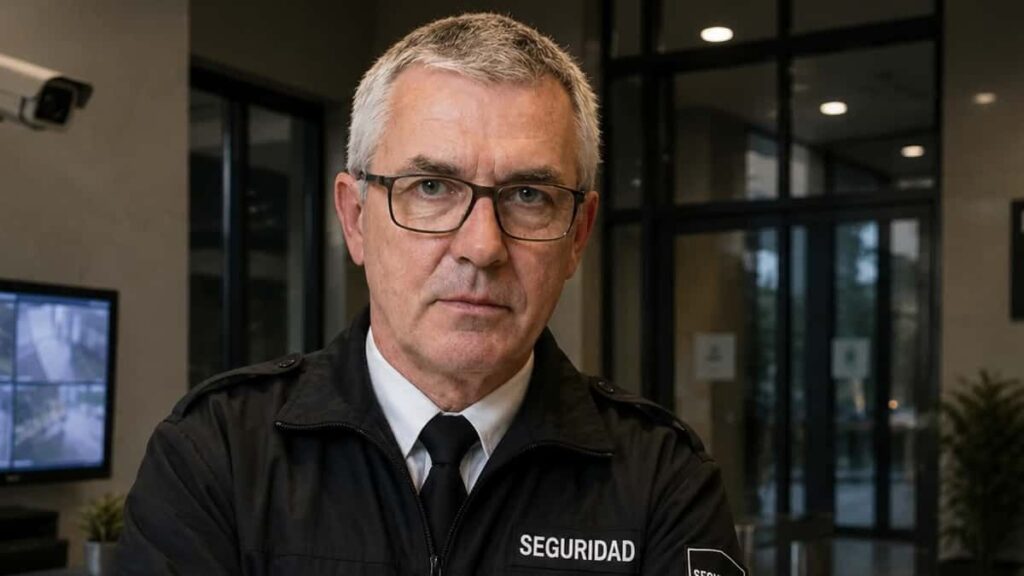


A 49-year-old security guard has managed to maintain a total permanent disability pension of 785.40 euros per month after Social Security tried to prevent him from recognizing the degree. The Superior Court of Justice of Catalonia considers that the almost total loss of vision in his right eye, added to an adjustment disorder and alcoholism with a clear loss of self-control, prevent him from performing the essential functions of his profession, which require visual acuity and attention beyond his reach.
According to the ruling STSJ CAT 2745/2026 (which can be consulted in this Judicial Branch Liaison), the worker, a security guard affiliated with the general Social Security regime, had had years of eye problems. Herpetic keratitis in the right eye, a corneal transplant in 2008 and a traumatic eye burst that ended in a trabeculectomy in February 2021 had left him with a very significant loss of visual acuity.

Ignacio de la Calzada, labor lawyer, advises when you can request permanent disability without exhausting the medical leave: “you can go ahead because the law establishes it”

Social Security denies permanent disability to a bricklayer with diabetes and a chronic ulcer and the Court endorses it: he did not meet the minimum contribution period
At the end of 2023, he requested recognition of his permanent disability, after a first file had been rejected by Social Security, considering that his injuries did not reach a sufficient degree to prevent him from working.
The new opinion of the medical court, the ICAM, set the effective date at January 31, 2024 and described a residual condition supported by the loss of visual acuity of the right eye, a reactive adaptive disorder and alcoholism with a direct impact on his ability to self-control.
The Social Court number 1 of Girona ruled in favor of the worker in July 2025 and recognized the total permanent disability for his usual profession, with a regulatory base of 1,428.80 euros per month and a pension equivalent to 55% of that amount. Social Security did not accept the ruling and took the case to the Superior Court.
To understand the case, it is worth remembering that total permanent disability is recognized when a person cannot perform the essential functions of their job, although they could dedicate themselves to a different job. At this level, Social Security pays a pension equivalent to 55% of the regulatory base, and the determining factor in granting it is comparing the worker’s ailments with the specific demands of their profession, not with those of any position.
A job that requires visual acuity and self-control that he no longer had.
The Superior Court of Justice recalls that ailments are not evaluated separately but rather together, and that a worker may become incapacitated for a profession although each injury, evaluated in isolation, would not be sufficient to recognize the benefit. The judges rely on the assessment guide used by Social Security itself, according to which the position of security guard requires a high level, three out of four, in visual acuity, ability to make decisions, attention and response under pressure.
The almost total loss of vision in one of the eyes, which reduces the worker to monocular vision, alone disqualifies a guard for tasks that depend on the perception of the environment and the speed to notice a danger. Added to this visual problem is alcohol consumption with a clear impact on self-control, which in a private security job compromises the reliability of any decision. The combination of ailments makes it impossible for the worker to continue practicing his profession, even if on paper he could still sign a contract.
For all these reasons, the Superior Court of Justice of Catalonia rejects the Social Security appeal and recognizes this Social Security guard with a permanent disability whose regulatory base is 1,428.80 euros, so, as it is a total disability, he will receive 55% of said base.