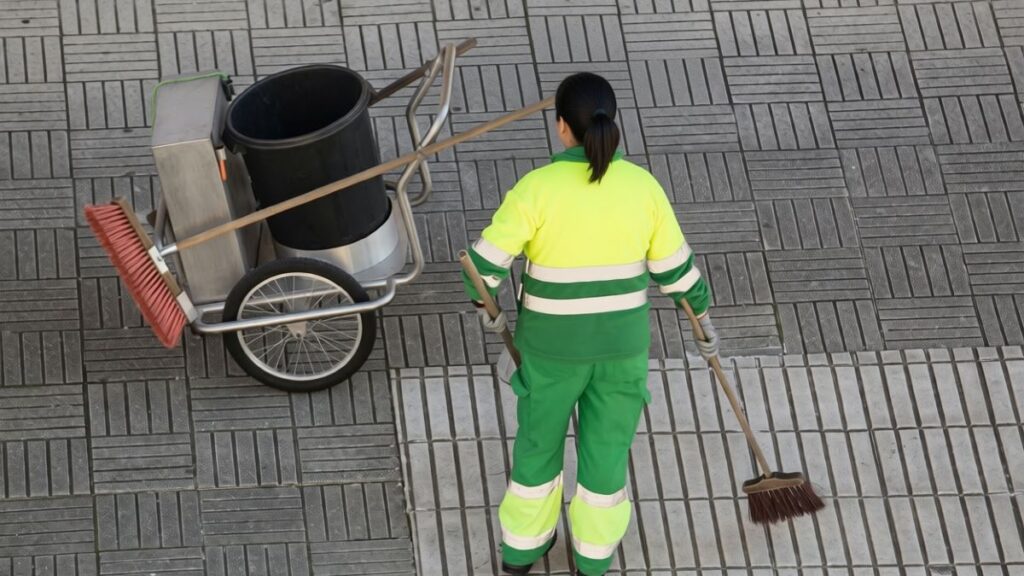
The Superior Court of Justice of Castilla-La Mancha has recognized the right of a sweeper to receive total permanent disability due to her multiple physical and psychological pathologies, including post-surgical thyroid problems and breathing difficulties, which prevent her from making physical efforts and standing for long periods of time. Thus, she has become the beneficiary of a monthly pension for life equivalent to 55% of her regulatory base of 1,110.67 euros (so the amount she would have left would be around 610 euros per month).
The clinical picture of the 46-year-old worker, at the beginning of the process, presented, among other pathologies, hypothyroidism after radical thyroidectomy due to thyroid nodule with vocal cord injury; severe cavus feet; moderate sleep apnea syndrome; chronic depressive disorder, anxiety with emotional instability personality disorder and history of cocaine and alcohol use.
These pathologies prevented her from performing physical exertion, repetitive work, carrying moderate weights, standing still, walking continuously (especially on uneven terrain), working in the cold or humidity, and doing other tasks that required continuous speaking or attention to the public. In fact, the endocrinology reports explicitly advised that he avoid “long periods of standing” due to his hypocalcemia, as stated in ruling 2547/2025.
Social Security denies her disability and the woman claims
In this situation, the worker requested the National Social Security Institute (INSS) to receive the permanent disability pension, but the INSS, following a proposal from the Assessment Team, denied it. For this body, his injuries did not reach a sufficient degree of decrease in his work capacity to constitute a permanent disability.
After this denial, he decided to file a claim through the courts, with the Social Court No. 1 of Guadalajara upholding his claim. This ruled in her favor and declared her the beneficiary of a total permanent disability pension for her usual profession as a sweeper, derived from a common illness.
The INSS, not satisfied, appealed this ruling, presenting an appeal before the Superior Court of Justice of Castilla-La Mancha. In this, based on article 194.4 of the General Social Security Law (LGSS), they reiterated that the ailments of this worker did not reach a sufficient degree of decrease in work capacity to constitute a permanent disability in any of its degrees.
The TSJ of Castilla-La Mancha confirms the total permanent disability
The Superior Court of Justice of Castilla-La Mancha once again ruled in favor of the employee. This court recalled that this (total) degree is granted when the worker is disqualified from performing “all or the most important tasks” of his profession, requiring that the consequences be definitive and have a direct impact on the tasks of the trade.
According to the INSS Professional Assessment Guide, the sweeper position requires a considerable physical load, with requirements for dynamic standing (walking) of grade 4 out of 4 and walking on irregular terrain of 3 out of 4.
Given that the woman is limited in performing physical exertion or repetitive work, lifting, carrying, pulling or transporting moderate weights, as well as continuous ambulation and manual dexterity, the court concluded that “she does not have the capacity to perform, with due effectiveness and dedication, the fundamental tasks of her usual profession.”
Consequently, it dismissed the INSS appeal and confirmed that the woman was the beneficiary of a total permanent disability for her usual profession as a sweeper, with effect from the moment she ceased the exercise of said profession. The sentence was not final and could be appealed to the Supreme Court.