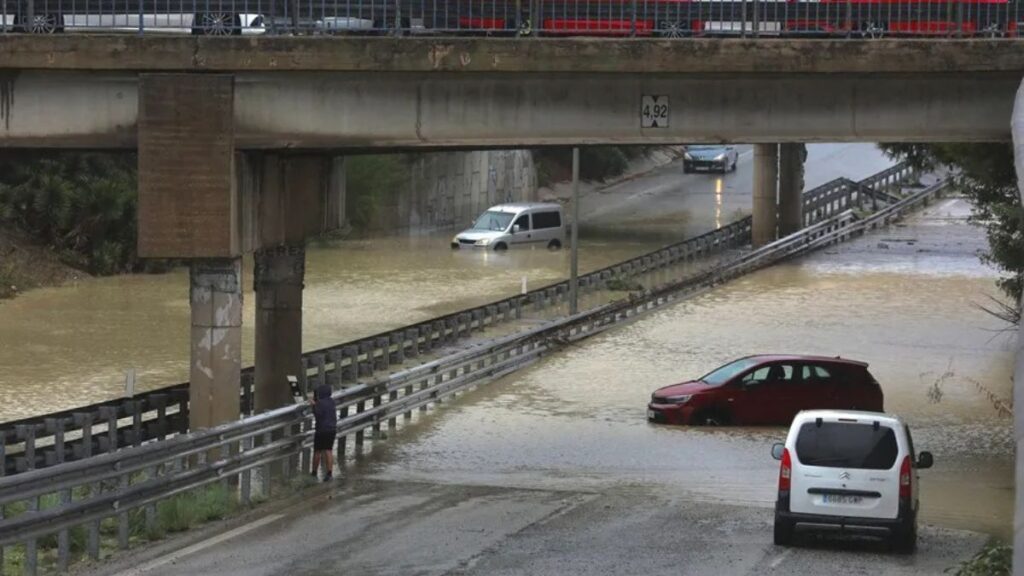
The General Directorate of Traffic (DGT) warns drivers of the arrival of Storm Marta, which, according to the forecasts of the State Meteorological Agency (AEMET), will bring heavy rains in the south and snowfall in the center and north of the Peninsula, which will complicate traffic during the weekend. Traffic recommendations indicate planning trips, checking the state of the roads and avoiding unnecessary trips, especially in the areas most affected by the storm.
The accumulated rainfall in recent weeks due to previous storms has left its mark on the road network. At this time, more than a hundred roads have incidents due to flooding, landslides and total cuts, both on secondary roads and on some high-capacity roads.
Saturday is shaping up to be the most complicated day of the episode, with active weather warnings and a high risk for traffic.
Andalusia and Extremadura, under the spotlight due to the risk of floods
The main concern is concentrated in Andalusia and Extremadura, where the warnings are yellow and even orange. In these communities, Traffic asks to avoid trips that are not strictly necessary and remembers a basic rule that continues to cause serious accidents: never cross flood zones or river beds, even if they apparently carry little water.
The authorities also warn of a particularly dangerous factor: even if it stops raining occasionally, the risk of flooding persists due to the saturation of the land. For this reason, the emergency services insist on taking extreme caution and following the recommendations of 112, which includes, in many cases, not taking the car.
Snow since Saturday: these are the most affected roads
Added to this scenario is the snow, which can cause significant traffic problems from 11:00 a.m. on Saturday until Sunday morning. The areas with the highest risk are located in the Cantabrian Mountains of León and the province of Ávila, although there is also a forecast of snowfall in large areas of the center and north of the peninsula, including the Community of Madrid and its metropolitan area.
According to the DGT, the highways and highways that could be most affected by snowfall are the following:
- A-52, in the section between Benavente (Zamora) and Ourense.
- A-6, both on the Madrid–San Rafael (Segovia) axis and between Benavente and Lugo.
- AP-6, between Guadarrama (Madrid) and Adanero (Ávila).
- A-66 and AP-66, in the corridor between Asturias and León.
- AP-61, between Segovia and San Rafael.
- AP-51, between Ávila and Villacastín.
- A-1, on the Madrid–Burgos section.
- A-15, between Medinaceli and Soria.
- A-2, between Guadalajara and Calatayud.
Given this scenario, Traffic does not rule out applying restrictions to truck circulation, limiting speed, prohibiting overtaking or establishing preventive cuts and mandatory detours if conditions require it. Also remember the obligation to drive with winter tires, all-season tires or chains when necessary, as well as leave the left lane clear to facilitate the passage of snow plows and maintenance equipment.
To follow the evolution of the storm, drivers can check the status of the roads in real time through radio bulletins, the etraffic.dgt.es website, the official accounts @DGTes and @informacionDGT on