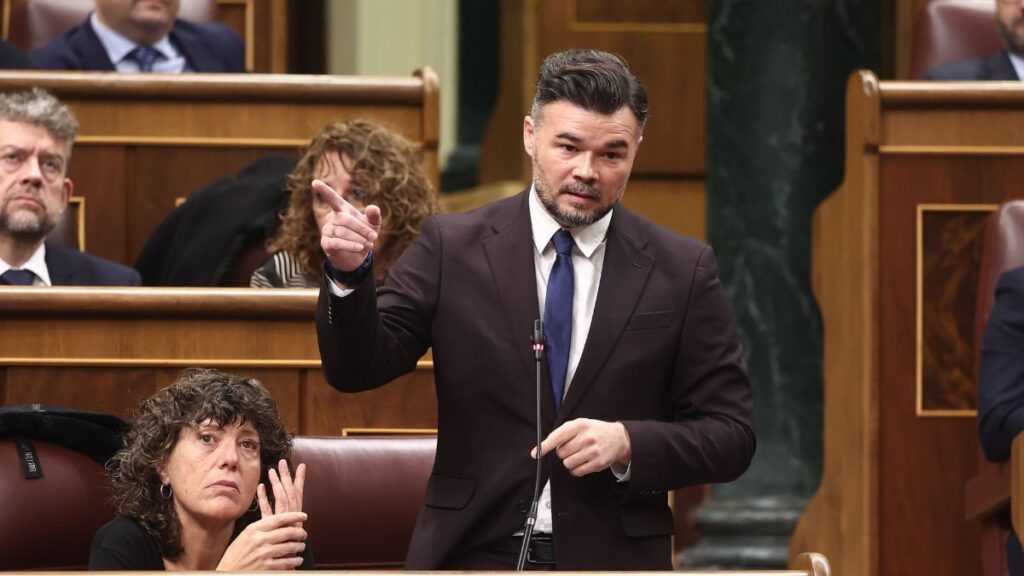
Esquerra Republicana de Catalunya (ERC) has urged the Government to include the ban on evictions and the extension of rental contracts that expire in 2025 and 2026 within the decree of economic measures that the Executive plans to approve this Friday in the extraordinary Council of Ministers to contain the economic impact of the conflict in Iran.
The training proposes a broad package of economic, fiscal and social measures with the aim of containing inflation and strengthening the protection of the most vulnerable households.
ERC defends that the decree must go beyond temporary measures and recover instruments of the so-called “social shield” deployed during the pandemic and the subsequent inflationary crisis.
Housing and social protection at the center of the measures
Among the most notable proposals is the ban on evictions, a measure that the PSOE has supported in the past but that has not prospered in Congress due to the opposition of PP, Vox and Junts. Likewise, the Republicans propose the automatic extension of rental contracts, an initiative that Sumar has been defending, although so far without the support of the socialists.
In the field of housing, ERC also proposes freezing at 0% the update of the Reference Index for the Update of Housing Leases (IRAV), the indicator introduced by the Housing Law to replace the CPI in the review of rents.
The training led by Gabriel Rufián also calls for strengthening the price control of fuel and basic products by the National Markets and Competition Commission (CNMC), as well as recovering bonuses for public transport during 2026.
On the fiscal level, ERC proposes reducing personal income tax for low incomes and, in parallel, increasing the contribution of higher incomes and capital. In addition, it proposes studying an extraordinary tax on energy companies in the event that they register high profits as a result of the international situation, a formula already partially applied in previous years.
The package also includes measures aimed at easing the financial burden on households, such as limiting the increase in mortgage payments linked to the Euribor, as well as accelerating the energy transition by promoting renewables, shared self-consumption and energy storage.
Finally, ERC urges the Government to defend before the European Union exceptional measures to support the agricultural sector, especially affected by the increase in production costs. The proposal is framed in a scenario in which Brussels has begun to study possible coordinated responses to geopolitical tensions and their economic impact.