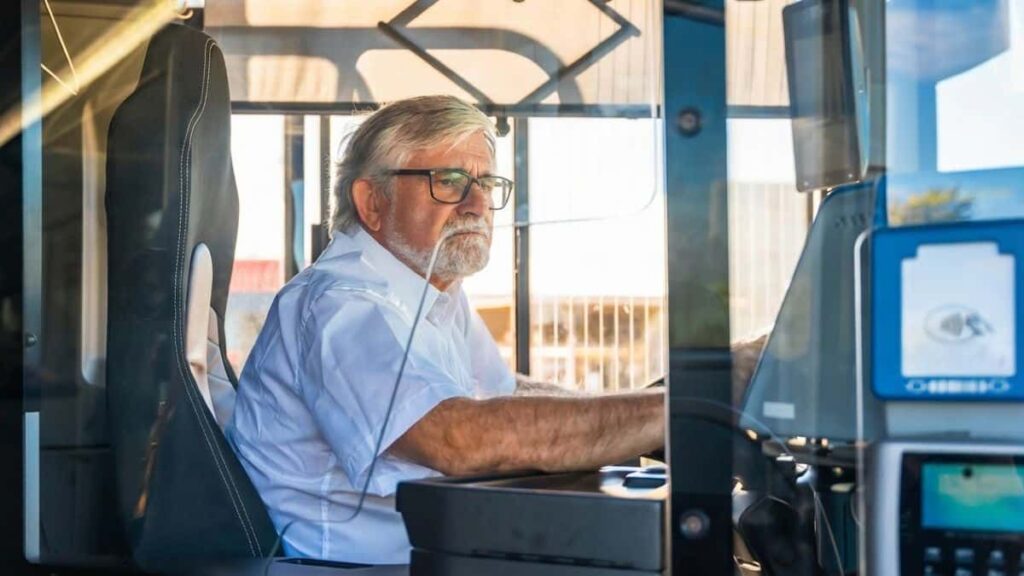
The Superior Court of Justice of Asturias has recognized the right to collect total permanent disability from an ALSA driver, since his injuries to the spine and right shoulder prevent him from continuing to work in his usual profession. Despite the fact that Social Security refused because he had not lost the capacity and that he even maintained his driving license, the court determined that he has the right to a lifetime pension of 75% of his regulatory base set at 1,841.04 euros.
The worker, born in 1968, worked as an ALSA driver and was on medical leave and after exhausting the maximum duration of temporary disability allowed by the General Social Security Law, the Medical Inspection issued a discharge with a proposal for permanent disability, which was denied. Although he complained, it was still denied.
The situation became complicated, since he was subsequently fired on May 14, 2024 for objective reasons, due to “surgent ineptitude”, that is, a objective dismissal after being declared unfit for his position. In other words, he was left without a job because he was not “fit” and without benefits because his injuries did not prevent him from working.
According to the ruling, the medical reports showed that the worker suffered from osteophytes and disc bulges in the lumbar spine, degenerative changes, cervicoarthrosis, disc protrusions with root involvement and, in the right shoulder, a “full thickness partial rupture” of the supraspinatus tendon, in addition to tendinitis, severe degenerative changes and bursitis.
When he went to court, the Social Court recognized his total permanent disability, so the INSS went to the Superior Court of Justice of Asturias alleging that the worker’s injuries and limitations did not demonstrate a sufficient loss of capacity to continue working as a driver. He even defended that there was no decline in manual dexterity and that the validity of the driving license showed work aptitude.
He cannot continue working as a bus driver
The TSJ of Asturias does not share this criterion and explains that article 194 of the General Law of Social Security, understands total permanent disability as that which “disables the worker from carrying out all or the fundamental tasks of said profession.” From this basis, he explains that this type of disability must be assessed taking into account legal, personal and labor components, that is, not only the medical diagnosis, but also how these consequences affect the specific work carried out by the affected person.
The ruling indicates that the worker has “impairments to the spine” and right shoulder, and adds that these are “permanent alterations, which cause pain and limits.” The TSJ recalls that, according to the Professional Assessment Guide of the INSS itself, this profession presents relevant physical and biomechanical demands in the cervical, dorsal and lumbar spine, shoulders, load handling and, especially, in sitting posture. That is, it requires sustained physical tolerance that the worker no longer maintains.
Therefore, the Court concludes that, “combined physical condition, functional limitations and professional requirements”, the declaration of total permanent disability is correct. Furthermore, it expressly clarifies that “the recognition of permanent disability is not based on the deprivation of the driving license,” but on the incompatibility between its consequences and the fundamental tasks of the position.
What the TSJ of Asturias finally decided
With all this, the Superior Court of Justice of Asturias rejects the Social Security appeal and grants total permanent disability due to a common illness for the profession of bus driver, with the right to receive a benefit of 75% of the regulatory base of 1,841.04 euros, with effect from May 15, 2024.
The key to the resolution is clear. The court does not say that the worker is incapacitated for any profession, but it does say that he can no longer perform the essential functions of a bus driver normally, efficiently and safely. That is why it confirms your right to total permanent disability.