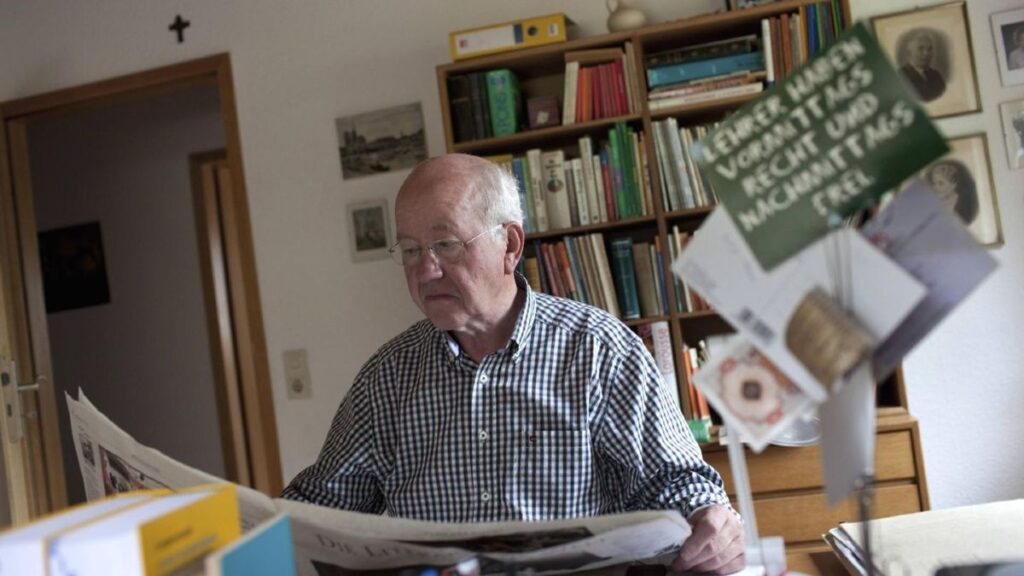
A 65-year-old teacher is about to retire and, although he will have a high pension, he feels unfairly treated, since his colleagues receive even more. He will have a gross pension of 2,600 euros left, which will translate into a net monthly income of 2,100 euros, but it is still not enough for his aspiration.
“I am a teacher at a comprehensive education center in North Rhine-Westphalia (a region of Germany) and I am an employee. This means that I contribute to pension insurance just like other employees,” he declares at the beginning of his story for the German media. Stern.
But there are differences between the pension of the tenured teachers of a center and the teachers hired under a collective agreement, as is your case. To compensate for this difference there is a complementary pension plan, although as they explain the difference in the end it is impossible to compensate.
“I receive a pension of 2,200 euros, plus an additional 400 euros in complementary benefits. A pension of 2,600 euros would be good, but I only reach that figure because I have held a managerial position for more than 15 years,” the professor clarifies about his situation.
Teachers’ pensions in Germany can vary greatly depending on their employment situation. In the case of civil servants, the standard pension is usually between 1,600 and 1,800 euros per month, to which about 300 euros in complementary benefits can be added. If you look at retirees as a whole, the average pension exceeds 3,000 euros per month.
How is a teacher’s pension calculated in Germany?
The final amount depends mainly on two factors: the last gross salary and the years worked. The salary grade and the level of experience achieved throughout the professional career also influence. In Germany, many teachers end their careers within the A13 salary group, which is the usual salary group for teaching.
For each full year worked, the system recognizes approximately 1.8% of salary as pension rights. This percentage accumulates year after year until determining what part of the last salary will be collected when you retire.
The maximum limit is around 70% of the last gross salary. The majority of tenured teachers reach that percentage after about 40 years of service.
In practice, explains the teacher who is the protagonist of the testimony, many teachers are at level A13 with experience level 12 shortly before retiring. In regions such as North Rhine-Westphalia, that roughly equates to a gross salary of around 6,200 euros per month.
“If you apply the 70% calculation, that means a pension close to 4,300 euros per month,” he points out.
“Personally, I find it unfair.”
The situation changes quite a bit for teachers who work as employees and not as civil servants. Their pensions usually remain well below these figures.
The teacher explains it clearly: “Personally, I find it unfair. We do the same work in the classroom, but I am going to earn less than my classmates who have a permanent position.”
According to him, this difference is experienced with a certain resignation within the educational system itself. “In the end we have to accept it. We are two groups with different statuses. I just try to make sure that, with what I get in my pension, I can get ahead,” laments the professor.
For him, the problem is structural and it doesn’t seem like it will change anytime soon.
“This inequality is not going to disappear overnight. The federal states are not very interested in changing it.”
A system that benefits public accounts
The professor believes that the main reason is economic. In the short and medium term, he says, civil servant teachers are cheaper for administrations.
“States do not have to pay social security contributions for civil servants. The real cost of their pensions comes decades later.”
That means that the bill is carried over to future budgets, something that, in his opinion, makes it easier for the model to remain the same. “It is a problem that ends up falling on governments that are not even in power yet,” says this early retiree.
“No one really dares to address the problem”
The teacher also believes that there is a lot of political fear about addressing this issue: “Every time there is talk of changes in the educational system, no one wants to take responsibility if the matter ends up having economic consequences,” he says.
“The budget situation is complicated, but still no one really dares to address the problem.”
Furthermore, he points out that the possibility of protests in the educational sector is very limited. “In theory, contracted teachers could go on strike. But a strike in education would paralyze classes, and that is something that almost no one wants,” he explains.
The debate over civil servant status
For many policymakers, education continues to be considered an essential function of the State. That is why it is defended that teachers have, at least in part, the status of civil servants.
The teacher is clear about how ‘the deception’ of making them feel like officials works. “It is said that, to guarantee a stable and quality education for children and young people, teachers must be given civil servant status. Even if that generates inequalities,” he summarizes.
Even so, he believes that the system has important contradictions, especially with regard to pensions: “When salaries rise, salaried workers contribute more to social security. But this increase is hardly reflected later in their pension.”
On the other hand, he explains, civil servant teachers do not contribute to the public pension system, although their future pension is calculated based on their final salary: “Civil servants do not contribute to the pension fund, but their pension is calculated based on their last salary, which is usually higher. That difference is enormous.”
For the teacher, this is one of the great pending debates within the German educational system. “It is a topic that everyone talks about privately, but that very few dare to really raise,” he concludes.