The financial markets begin March with a scenario of high uncertainty after the start of the joint military operation between the United States and Israel against Iran, which began on February 28. The objective of this operation is to neutralize the Iranian nuclear program, with the result of the death of the historical supreme leader of the Persian country, Ayatollah Khamenei, in power since 1989, provoking an immediate response from Tehran, which has launched a wave of attacks against Israel and North American bases in the region (Qatar and the United Arab Emirates, Bahrain and Kuwait), in addition to blocking, as they had been threatening for some time, the Strait of Hormuz, through which the 20% of the world’s oil supply and approximately 35% of maritime trade. Iran is the power with the greatest influence in the Middle East, not only due to its large territorial area and high population, but especially its role as spiritual and political leader of the Shiite faction. This religious influence allows it to project its power beyond its borders, acting through strategic alliances in Iraq, Lebanon, Yemen and Syria. While direct oil production is limited to between 3% and 4% of global supply due to international sanctions and embargoes, it has always used the ability to block the strait to influence the global energy supply chain, just as it has done, the escalation of the conflict has caused the blockade in practice, causing insurers to cancel the policies of shipping companies, causing the end of operations in the region of these companies, having to look for routes alternatives, lengthening supply chains and causing sharp increases in the price of a barrel, which rose nearly 8% this morning (Brent $78.72 – WTI $72.11).
Graph 1: Maritime trade routes.
Source: Bloomberg
This strong rise in the price of oil has also been accompanied by notable increases in safe haven assets such as Gold ($5,404, +3%$), Silver ($95.51, +2.40%$) and other Raw Materials, as well as EUR/USD, appreciating this morning by 0.60%, placing it in the range of 1.1700/1.7500. On the other hand, the Equity markets have reacted negatively due to the effects that it may have on supply chains, as well as the impact that a higher energy price may have on the economy, accentuated in the European markets due to energy dependence and business issues of a more cyclical nature, and once again focusing on the effects that these prices may have on inflation. The key to how the conflict will affect financial markets will be the duration of Iran’s blockade of the economy, which will determine how much supply chains are strained and therefore what will be a real effect on the economy, but there will likely be great efforts to control and stabilize the region so that maritime trade can continue with some normality. On the part of NORZ, the position adopted in recent quarters both in precious metals and raw materials, as well as in specific geographical sectors, as well as in the vehicles advised with the different client portfolios, provides some coverage against this situation and should serve as a stabilization of volatility. For all these reasons, we consider that the current exposure is appropriate and the escalation or de-escalation of the situation will depend, as we have said, on the length of time that the Strait of Hormuz remains closed. At this point, we do not see the need to make major adjustments or significant changes in course in the portfolio strategy, thus maintaining calm in the face of this situation that we hope will not last over time, since as we have already seen in similar situations in the past, if there is no further escalation, the initial shock is the strongest and the market ends up recovering previous levels in relatively few weeks.
Table 1: market reaction to conflicts.
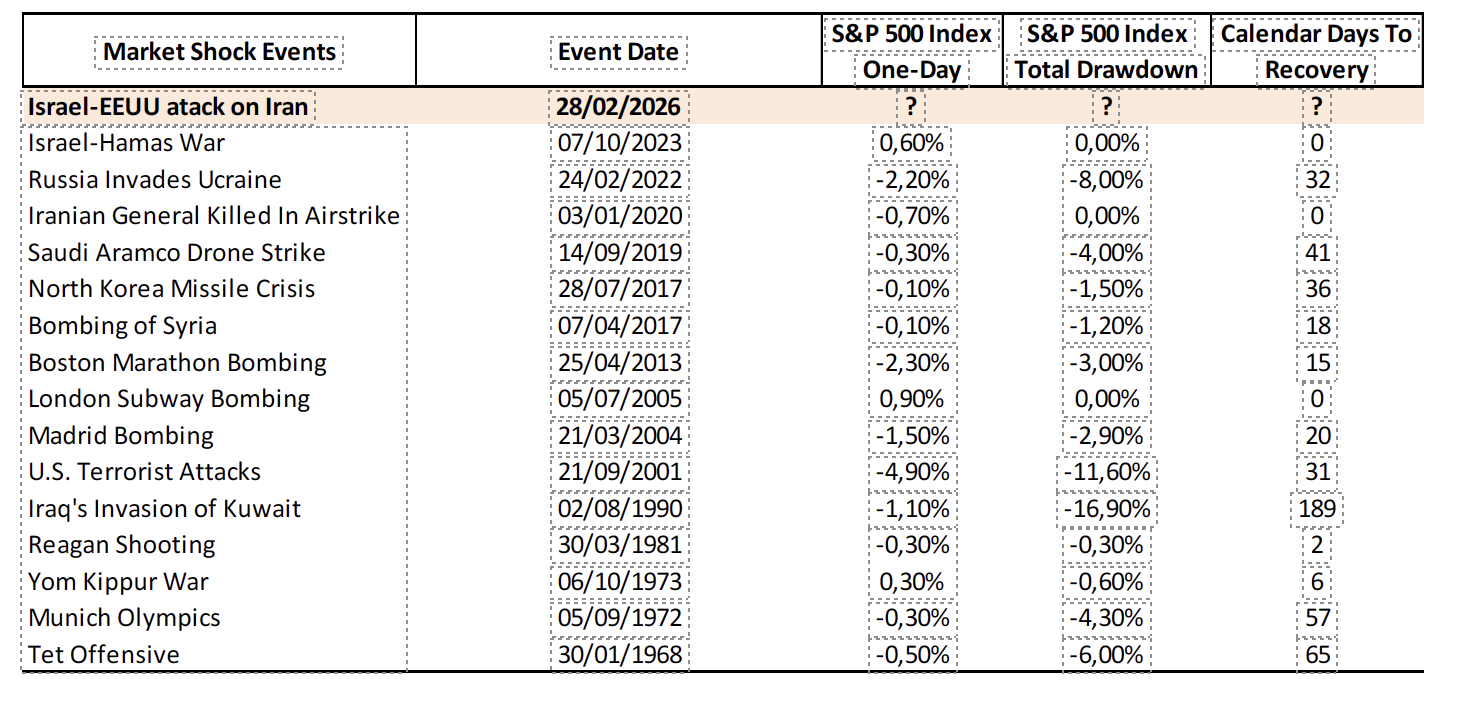 Source: Own elaboration.
We will continue to monitor the situation over the next few days and will make any necessary adjustments to adapt to the situation.
Investment Department – NORZ Patrimonia