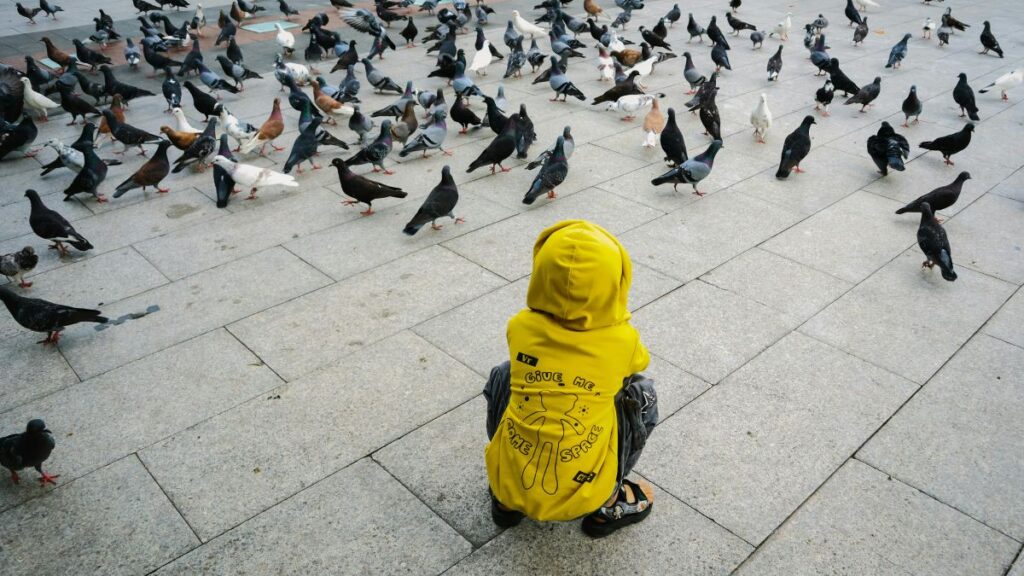
A gesture that seems harmless, such as giving bread to pigeons in a park, can lead to a fine of thousands of euros. The massive presence of these birds in many Spanish cities is no longer seen as a customary image, but as a problem that affects public health and coexistence.
For this reason, more and more city councils prohibit feeding them in the street, since doing so favors their uncontrolled reproduction and increases the inconvenience of neighbors. The penalties vary depending on the city and the severity of the case, but can reach several thousand euros.
The councils explain that these measures are adopted for reasons of health and maintenance of the city. Excrement damages buildings and street furniture, and the accumulation of birds can facilitate the transmission of diseases.
This is explained by the Alcalá de Henares City Council, which has recalled on its website that “it is totally prohibited to feed animals on roads and public spaces.”
Health risks and neighborhood nuisances
The city council of Alcalá de Henares justifies the ban by the need to “avoid or reduce health risks, prevent the transmission of zoonoses and reduce urban problems and inconvenience caused by urban birds, by controlling their population.” Among the diseases that can be associated with these birds are cryptococcosis, histoplasmosis and psittacosis.
Added to the presence of pigeons in the region and in this municipality is the expansion of the Argentine parrot, an invasive species that has colonized numerous parks and whose high reproductive capacity and noise level have generated neighborhood complaints in different Madrid municipalities.
Authorities point out that these birds reproduce more easily when they constantly find food. Therefore, feeding them on the street encourages them to become more numerous and to control them more complicated.
Criteria for grading sanctions
The fines provided for feeding pigeons on public roads in Alcalá de Henares range between 300 and 2,400 euros, as confirmed by the City Council itself. THE NEWSPAPER OF SPAIN.
To determine the specific amount, the council will take into account several criteria: the social or health significance and the damage caused by the infringement, the possible profit motive and the amount of the benefit obtained, as well as the repetition or recidivism.
The ordinance is part of an increasingly broad trend in Spanish cities that, in recent years, have tightened measures against the uncontrolled feeding of animals in the street, due to the proliferation of pigeons in urban environments.
The authorities ask citizens for responsibility, because this gesture can worsen a problem that affects health, the environment and coexistence.