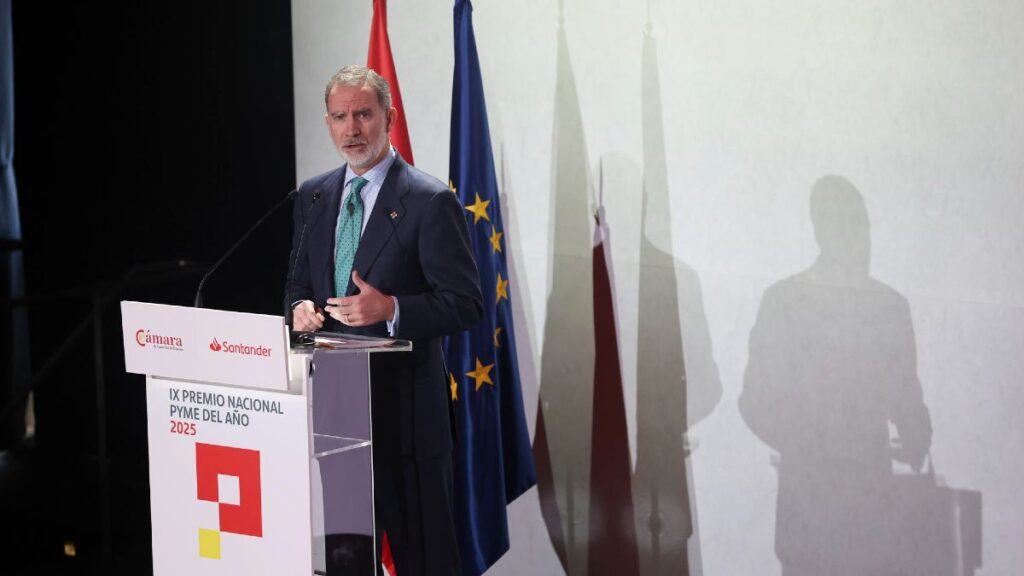
King Felipe VI has called to improve the conditions currently experienced by small and medium-sized companies, highlighting the need to guarantee “a stable environment, clear rules and collaboration” to promote their growth and international projection. For the monarch, SMEs are “the nerve of the Spanish productive fabric.” In this way, the king defended this group this Thursday during the presentation of the IX ‘National SME of the Year Award’, which this year was awarded to Tebrio Group SL, a biotechnology company from Salamanca.
In his speech, the king highlighted the structural role of SMEs in the Spanish economy. “From every corner of our geography, in every workshop, in every office, in every production line, you sustain employment, you promote innovation and you strengthen the ties that underpin our collective life,” he stated to the businessmen present. With these words the monarch recalled how important SMEs are for the national productive fabric and employment.
Digitalization, ecological transition and geopolitical tensions
For Felipe VI, the current world is experiencing a context of “profound transformation”, marked by the acceleration of digitalization (which is largely due to the enormous development of Artificial Intelligence), the ecological transition and an international scenario conditioned by new geopolitical tensions. These factors “pose real challenges, but also opportunities” to strengthen the competitiveness of the Spanish economy, “as long as we know how to do our homework well,” the king remarked.
In this sense, the monarch insisted that adapting, innovating and anticipating constitute an “indispensable” recipe to consolidate solid growth. But, he added, this business effort requires effective institutional support. “It is not enough to recognize your work; it is necessary to accompany it, especially when you face difficulties,” he highlighted.
The king specified that a stable and collaborative framework is a necessary condition to take advantage of key instruments such as financing, specialized training or regulatory frameworks that consolidate stable employment, facilitate technological innovation and open doors to new markets. “I encourage you to look further, to continue exporting and creating value with your ideas, with the confidence of knowing that you are accompanied by institutions and by society as a whole,” he concluded.
Also speaking during the event were the president of the Chamber of Spain, José Luis Bonet, who recognized the “audacity, courage and risk-taking” of the participating companies, and the president of Santander Spain, Luis Isasi, who stressed that these awards focus on companies that “generate stable employment, reinvest, innovate and compete without losing the link with their territory.”
Tebrio, SME of the year
The National SME of the Year Award 2025 was awarded to Tebrio Group SL, based in Doñinos de Salamanca. Its CEO, Adriana Casillas, highlighted that the recognition shows that “even from an SME you can change realities and create a global impact.”
The company is a leader in the industrial breeding of insects tenebrio molitor and in its transformation into ingredients for animal feed, organic fertilizers and industrial biotechnological applications. According to the information released, it uses its own patented technology in more than 150 countries and develops “zero waste” solutions that require up to 90% less water and 80% less arable land than traditional methods, without generating methane or ammonia emissions.
Tebrio is building a 90,000 square meter factory in Salamanca with the capacity to produce more than 100,000 tons of sustainable products per year. The project foresees the creation of 150 direct jobs and more than 1,350 indirect jobs, in an example of the combination between technological innovation and territorial development that the institutions seek to promote.
The event also served to recognize other companies with second prizes in different categories (Internationalization, Innovation and Digitalization, Training and Employment and Sustainable SMEs) at a time when the debate on business size, productivity and the export capacity of SMEs is once again at the center of the economic agenda.