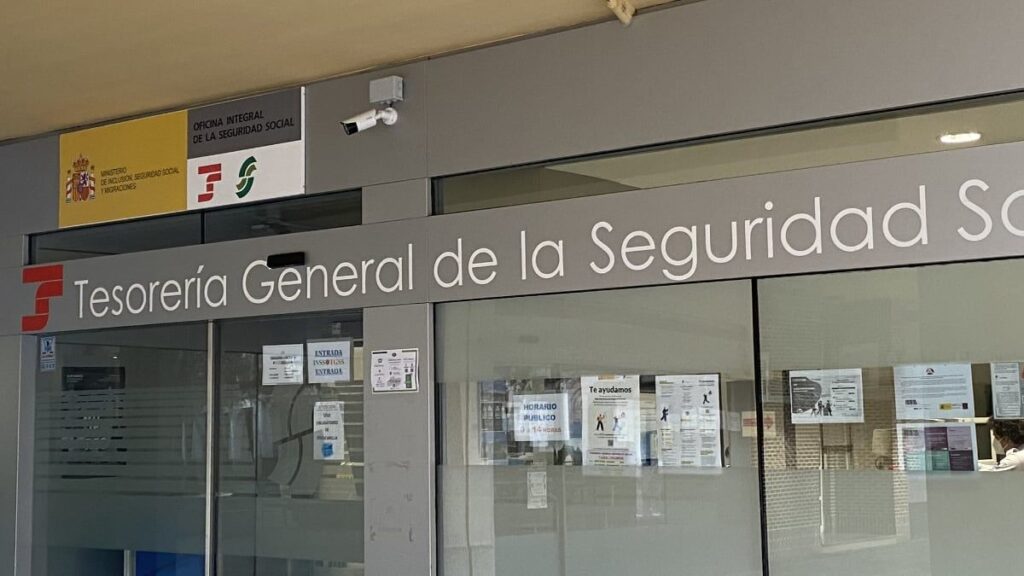
A 34 -year -old man who worked as a production operator in a León laboratory has achieved the permanent disability pension after the National Social Security Institute (INSS) was denied in the first instance. The Superior Court of Justice of Castilla y León considers that suffering the “Falling Back” syndrome was sufficient to grant the total permanent disability, so it will charge a pension equivalent to 55% of its regulatory base, set at 1,423.64 euros.
The worker began to suffer several lumbar problems that worsened over time. After several relapses, it was subjected to surgical interventions: an L5-S1 arthrodesis in April 2021 and, subsequently, the withdrawal of the intersomatic box with a bilateral TLIF L5-S1 in July 2022. Despite rehabilitative treatments, it developed a failed back syndrome, Functional limitations such as the difficulty in flexing the fingers of the left foot.
You may be interested
A clerk of El Corte Inglés with obsessive-compulsive disorder achieves the permanent disability pension after the Social Security decision appealed

Retirees charged 2,907.68 euros every month of social security
Due to the injuries and after exhausting the maximum duration of temporary disability, he decided to request the permanent disability to social security, but he denied it. The EVI (disabilities assessment equipment) proposed that it not be recognized, considering that “it did not present anatomical or functional reductions that decrease or annul their work capacity.” The INSS formally denied the pension and, after also rejecting the previous claim, the worker was declared not suitable for his position and dismissed by objective dismissal.
Injuries compromise their usual profession
Both the Social Court and, later, the Superior Court of Justice of Castilla y León proved the worker, despite the fact that social security argued that the ailments of the affected “were not creditor of the requested disability.” The TSJ corrected this criterion explaining that the total permanent disability is granted when a worker is impossible for the fundamental tasks of his profession, although he can perform others.
In this case, the Court indicated that the worker’s clinical picture (spondylolistesis, operations in the lumbar spine and persistent chronic pain) supposes limitations that “compromise the development of their professional activity, since it entails physical demands and requirements that can affect their ailments.”
The sentence adds that “to the date of celebration of the act of trial, there are serious ailments likely to determine permanent disability”, leaving open the possibility of future reviews if there is an improvement or substantial worsening. That is, if your situation changes, the degree of disability can be modified.
The court concludes that the disability is granted not by a single pathology, but by the set of physical limitations derived from operations and sequelae in the column. In addition, he remembers that his profession of pharmaceutical operator demands continued physical effort, permanence in maintained positions and manipulation of charges, which was incompatible with his ailments.
For everything, it will charge a life pension equivalent to 55% of its regulatory base, set at 1,423.64 euros, although it can be reviewed. The total permanent disability disables him for his usual profession, but allows him to work in another compatible with his limitations.