
A woman who worked as a saleswoman and suffering from lung cancer, fibromyalgia and other serious pathologies has made the Superior Court of Justice of Madrid recognize a pension for total permanent disability, after the National Institute of Social Security denied him. Although the plaintiff requested absolute disability and the Social Court was recognized, the TSJ has considered that, despite the seriousness of their ailments, there is no total impossibility to work, since it can still perform tasks of less physical demand.
The woman, by clerk profession, began to suffer from health problems, which after testing the doctors diagnosed her fibromyalgia with poorly controlled pain, anxious-depressive syndrome and, in addition, a pulmonary nodule of 2 cm in the lower right lobe, pending diagnostic confirmation by PET-TC, compatible with a possible lung cancer.
You may be interested
Social Security will add years of contribution that remain until the retirement age to the workers who access through a permanent disability

A widow and her children get rid of returning 11,272.94 euros to Social Security for a pension charged more by the deceased: Justice acknowledges that they never accepted the inheritance
Given the clinical picture, the woman began a decrease due to temporary disability October 19, 2021, derived from common illness. But, its state of health did not improve, since, in addition to chronic pain and extreme fatigue, it presented important limitations, such as difficulty standing, manipulation of weights and concentration problems due to medication and lack of rest.
Due to this situation since its state of health did not improve, it decided to request social security recognition of permanent disability, being denied. Apparently, the disabilities assessment team (EVI) explained that “injuries do not constitute permanent disability today” and argued that “the injuries suffered do not reach a sufficient degree of decrease in their work capacity, to be constitutive of a permanent disability” according to article 194.5 of the General Social Security Law (in its prior writing to Law 24/1997, applicable to the case).
The disease allowed him to do lighter jobs compatible with total permanent disability
Despite the refusal of the Social Security, the plaintiff decided to go to the Courts and the Social Court number 2 of Madrid gave the reason to the worker and recognized the right to receive the permanent disability in the degree of absolute. That is, the impossibility of working for any job and with a life pension equivalent to 100% of the regulatory base. The court understood that his clinical picture prevented him from developing any work activity, even the most sedentary.
Not in accordance with this decision, Social Security filed an appeal for begging the Superior Court of Justice of Madrid, which is, after reviewing it, decided to continue granting the disability, but lowering its degree to the total. The TSJ explained that “there is no absolute impossibility for all types of work”, since the worker can still perform “more sedentary tasks, with the possibility of postural alternation and null or very scarce physical requirements in terms of pesos or adoption of maintained postures.”
Therefore, he partially estimated the social security appeal, modifying the degree of incapacity recognized and granting only the pension for total permanent disability, equivalent to 55% of the regulatory base and not 100% as the Social Court had granted.
Impossibility of performing physical demand work
In this judgment, the key is that the Superior Court of Justice understood that the pathologies, although serious, did not prevent him from developing more sedentary work activities. That is, the total degree of disability is the one that limits for the usual profession, but leaves open the possibility of performing another activity compatible with its limitations.
The court also clarifies that, although the diagnosis of fibromyalgia and the other ailments are relevant, “it is not possible to confuse the scope of these sequelae with the absolute lack of work capacity”, so the recognition of absolute disability does not proceed. At this point, we must understand that a degree is not recognized only by the fact of suffering a disease, but based on how it really affects the working capacity of the working person.
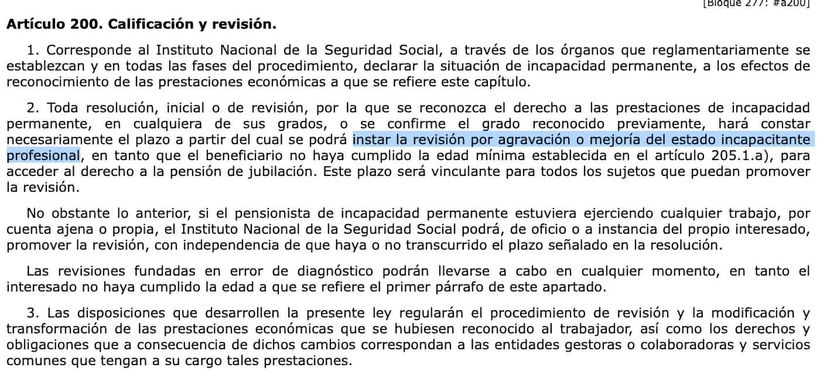
In addition, this degree is reviewable, as stated in article 200 of the General Social Security Law (You can look at this official state newsletter). Then, and to summarize, if your situation is aggravated in the future, it could request recognition of the absolute degree and perceive 100% of the regulatory base, although this would imply not being able to exercise any work activity.