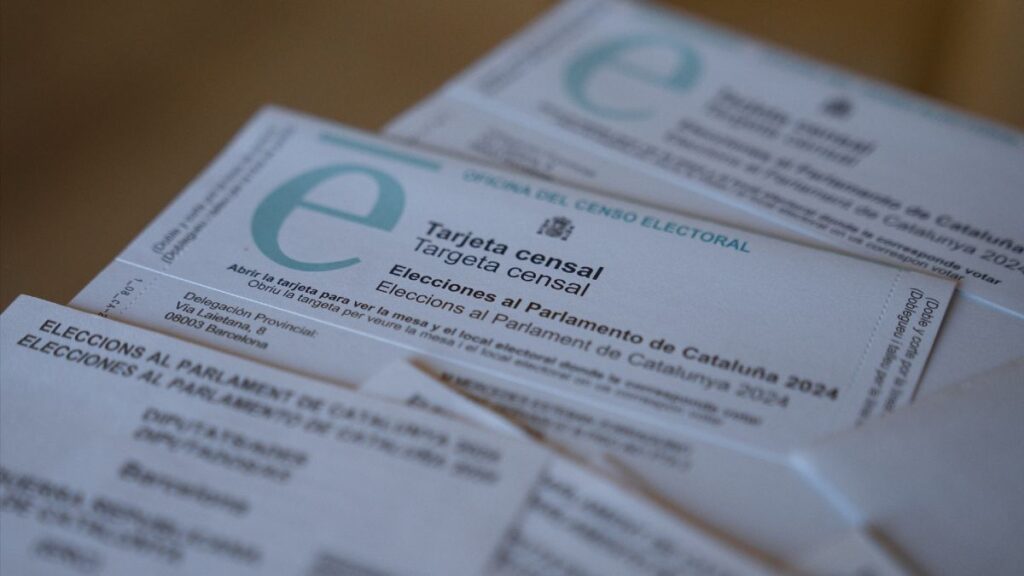
Voting on general election day, November 29, can raise several doubts for the thousands of citizens called to the polls. One of them is whether requesting a vote by mail, designed for those who anticipate that on election day they will not be in their town or will not be able to go to the polling stations, closes the way to vote in person, because the Electoral Census Office notes the request “so that on election day the vote is not carried out in person”, as established in article 73.1 of the Organic Law of the General Electoral Regime (LOREG).
The deadline to leave the envelope at the Post Office ended on Thursday, November 26, at 2:00 p.m., one day later than expected, after the Central Electoral Board extended it on November 19 at the request of the PP (agreement 418/2026). In the same agreement, he ruled out other measures, because the reports from the Census and Postal Office warned of the problems that could be caused by changing the deadlines for requesting and delivering votes by mail.
In addition, that week, the Free Union of Postal and Telecommunications had called a strike from November 23 to 27 in the Community of Madrid and from 23 to 25 in Cádiz, Córdoba, Huelva, Málaga and Seville, with minimum services set by the Ministry of the Interior in Order INT/1239/2026, in a campaign in which CSIF and CCOO had already claimed 15,000 and 20,000 reinforcements.
Can you vote in person if the mail-in voting documentation has not arrived?
No, and proof of this is that to a voter who had not received the documentation in 1995 and wanted to vote at her table, the Central Electoral Board replied that this does not apply to those who have requested a vote by mail (agreement 737/1995), exempted Correos from responsibilities and forwarded the complaint to them for information.
He said the same thing in November 2011, two days before the general elections, when the president of the Provincial Electoral Board of Barcelona proposed letting those who had not received the ballots on time vote at the table (agreement 724/2011), because for the Central Electoral Board the prohibition still stands even if the documentation arrives late and even in the event that the Post Office does not bring the vote to the table.
Much earlier, in 1991, the Constitutional Court had already accepted this reading in ruling 169/1991. The case was that of three voters from Torresandino (Burgos) who in the municipal elections that year were not able to vote at their polling station because they had requested a vote by mail, while the president of that same polling station, who had also requested it, did vote in person, and that vote was later considered invalid. For the court, the law does not allow the ban to be lifted when the documentation arrives late, and it is up to the Census Office and the Post Office to carry out the process diligently, so it denied protection to the CDS (Democratic and Social Center), which asked to annul the election.
What happens to the vote by mail that has already been sent?
The Post Office keeps the envelopes that have already been sent until the day of the vote and takes them to each table at 9:00, and those that arrive that same day continue to be delivered until 8:00 p.m., as required by article 73.4, while those received after that time are sent to the Zonal Electoral Board.
When the voting is closed, the president of the table puts them in the ballot box, but not before checking to see that the certificate of registration in the census is inside and that the voter appears on his lists. The vote of the voter who dies before the elections is also excluded, as long as the death is proven in time with the death certificate.
Not all those who request it vote this way, and in the general elections of 2000, 2004 and 2008, votes by mail were between 90.9% and 92.9% of the requests, and in 2011 the Post Office had registered, two days before the vote, 621,004 envelopes, 91.6% of those who had requested it, according to the data collected by the Central Electoral Board in the agreement 724/2011. That is, between 7% and 9% of the requests did not translate into a vote by mail.
Anyone who does not know if their documentation has arrived can check it by checking the status of the shipment at the electronic headquarters of the National Statistics Institute (INE), which requests the identity document and date of birth.
Correos stands before the general elections and announces a strike from November 23 to 27 in Madrid and Andalusia
He is fired from the Post Office after 21 years with temporary contracts and the court recognizes him as permanent: he must be reinstated or compensated with 45,920 euros
Now, the prohibition is linked to that notation in the census, because the criteria of the Central Electoral Board that is cited in the Constitutional ruling refers to whoever has requested the vote by mail “and made the corresponding notation in the census.” In the college, the person who decides is the president of the table, who has exclusive authority in the premises and can consult the corresponding electoral board on the questions that arise, as the Central Electoral Board reminded in agreement 661/1999 to a voter who had not been allowed to vote in the June elections of that year.