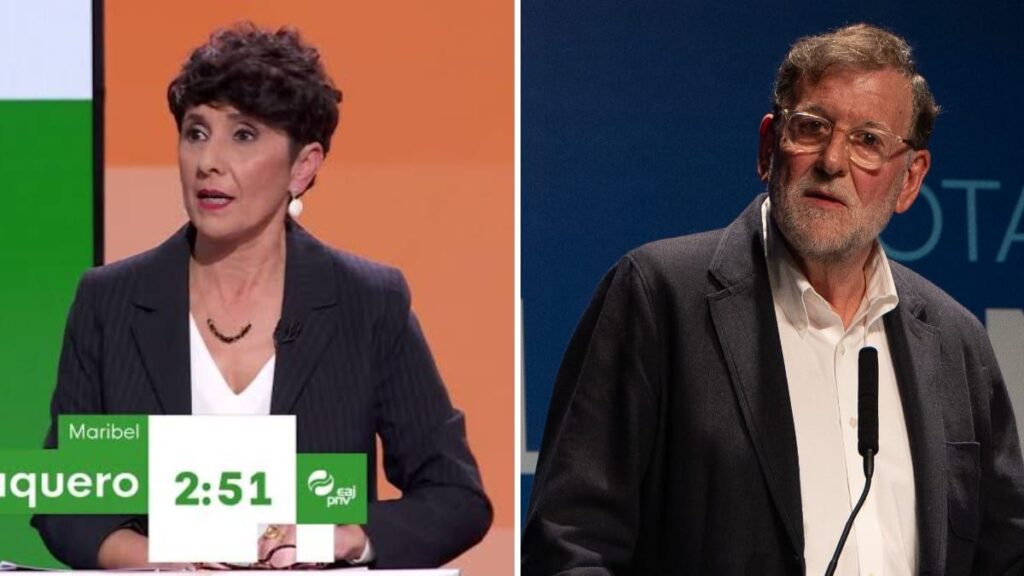
Maribel Vaquero wanted to make it clear to the PP in the eight-person debate on RTVE who pushed the increase in pensions in 2018, which was 1.6% for the majority, after four years in which they had only risen 0.25% per year. “I want to remember a date, April 25, 2018. That day the PNV forced the Rajoy Government to revalue the pensions,” said the PNV spokesperson in Congress, who raised it as a condition that her party set to approve the Budgets.
Vaquero took out the pensions at the end of the first block, after Ester Muñoz and Oskar Matute argued about whether or not the PP spokesperson said that the system “is going to fail.” “We were coming from a financial crisis and until that moment they were not revaluating. From that moment on it has been done every year,” he added. Muñoz tried to add a nuance from his lectern, but Vaquero did not let go: “We had to force you to reach that agreement, because you do not want to revalue the pensions and you were not doing so during the previous years.”
Then she closed her shift with what, according to her, was “a work of the Basque Group in Madrid.” “For us, pensions are very important, we have to give security to older people, they have to be revalued,” he points out.
What was agreed in April 2018
The agreement existed, being on April 25, 2018, because that day, just before the debate on the entire Budget, the then PNV spokesperson, Aitor Esteban, announced that he would support them after the Government of Mariano Rajoy agreed to raise all pensions by 1.6% that year and delay until 2023 the sustainability factor, which was going to cut new pensions. The increase ended in Budget Law 6/2018, which added 1.35% to the 0.25% that had already been applied in January and raised the minimums by 2.75% more, to 3%, although this increase in the minimums already came in the project that the Government approved in March. The law came out in the BOE in July, when Pedro Sánchez was already president after the motion of censure, and the same rule left another 1.6% for 2019 if there was no agreement in the Toledo Pact.
Of course, when Vaquero says that before “they were not revaluating”, he leaves out that between 2014 and 2017 pensions rose every year, even if it was only 0.25%, which was the minimum that Law 23/2013 approved by the PP allowed to rise. The year without an increase was 2011, when the Zapatero Government froze them and only the minimum, non-contributory and those from the old SOVI that are not collected with another pension were released.
Table with the increase in retirement pensions in 2027 and how the minimum and maximum amounts are and according to your payroll
Social Security denies a lifetime widow’s pension to a woman who continued living with her ex-husband after the divorce for registering as a common-law couple five months before he died
As of 2018, there has not been a year without an increase, and since 2023, article 58 of the General Social Security Law establishes that pensions will be revalued according to the average CPI from December to November. In this way, in 2023, pensions rose by 8.5% and now the PP continues to maintain that pensions “rise every year with the CPI.”