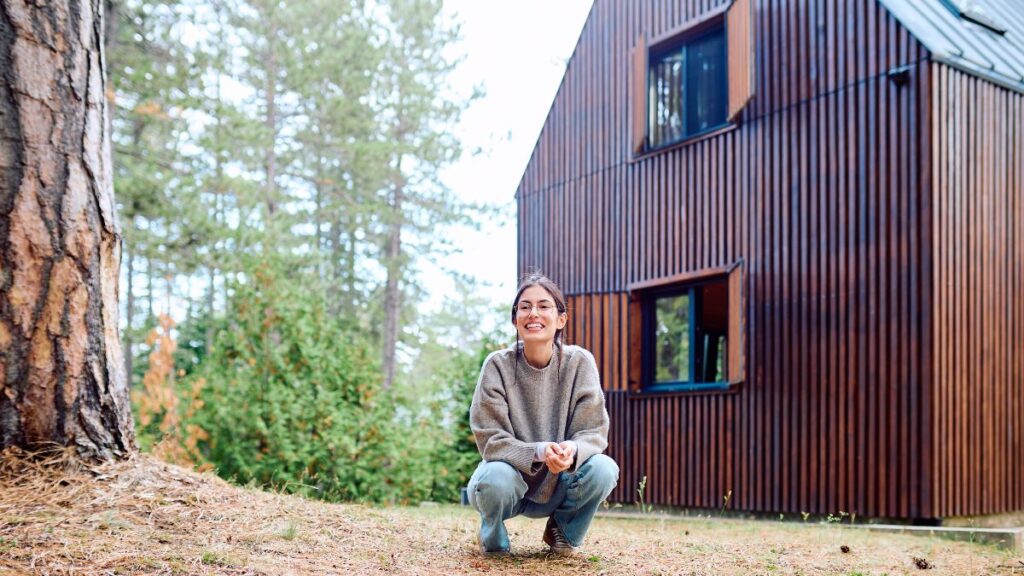
Tervola is a municipality in Finnish Lapland in which it has not gained residents since 1991 and in 2025 that streak ended, as it reached 2,833 inhabitants, as shown in the provisional data from the town hall’s annual accounts. Sara Saarenpää, a 23-year-old girl who spent her childhood between Oulu and the countryside of Rovaniemi, went to live alone in this town and bought a house to have what the city did not give her.
In an interview by journalist Hanna Koivisto for the Finnish magazine Maalla (which in Finnish means “in the countryside”), explains that “the city always seemed a little cramped to me, and I knew I missed having space, forests and tranquility around me.”
He bought the house from a person he made friends with through horses and whose house he went to a lot when he was younger. It is a rintamamiestalothe name given in Finland to the wooden houses that were built throughout the country in the years of reconstruction after the war and that, as public television Yle explained, could be built without knowing carpentry and with little money.
“When I moved, I broke up with my partner and I came here with my cat, just the two of us,” she remembers. Since then the family has grown, as an East Siberian Laika dog now also lives with her.
“I can do my work in Rovaniemi and remotely”
His closest neighbor lives half a kilometer away and the road, with a gas station, is a couple of kilometers away, but moving house has not cost him his job. “My position, in equipment leasing financing, is still in Oulu, which is where I came here from, but I can do my work in Rovaniemi and remotely,” he says.
From Tervola there is just over 110 kilometers of travel a day, a distance that one gets used to and becomes more bearable if taken with the right attitude, according to the report, and that Sara has accepted as part of living in the countryside. The city council itself, in fact, boasts on the page dedicated to living in Tervola that it is in the center of Kemi, Tornio and Rovaniemi, which allows you to go to work in several directions, and that it has fiber optics for those who work remotely.
Teleworking is very common in Finland, more than in Spain. In fact, in 2025, 20.5% of employed people aged 15 to 64 worked from home regularly in Finland and another 21% did so occasionally, while in Spain this percentage remains at 7.9% and 7.8%, according to Eurostat data.
In the case of Spain, going to live far away and teleworking from there first passes through the company, since anyone who teleworks regularly (at least 30% of the day in a period of three months) has to sign a written agreement that includes, among other things, the place they have chosen to work remotely, as required by Law 10/2021, on remote work. Changing it must also be agreed upon in writing beforehand, and anyone who is going to telework somewhere else without doing so is even exposed to dismissal.
“I have learned to live with what is half done”
Sara admits that living alone in a house has been a good school, although at times it has also been hard for her. “I have had to learn things that were not seen in a block of flats. That has made me stronger and more determined,” she says. She has taught herself to heat the house, to use different tools and to take care of the garden.
In the city, a good part of his free time was spent watching television, and now he enjoys turning on the wood oven or the sauna in the garden and removing the snow. In addition to other repairs, “my sister and I set up the scaffolding, removed the old paint from the exterior walls and painted the house,” he says. “That feeling of seeing the imprint of your own work gives you a lot of strength,” he adds.
“I have become independent, I have learned to live with what is half done and get to work without anyone having to be by my side giving me advice,” explains Sara, to whom every thing that goes well leaves her “a feeling of strength, of being empowered.”
“At home you don’t have to be afraid”
Sara does not hide that at first the countryside imposed itself on her. “At first, the silence and darkness of nature made me nervous, but at home you don’t have to be afraid,” she admits. Now he talks about what he sees without leaving home: “I love that from the window I can see the forest and that in my own garden I can see how the seasons change.”
And she adds: “When I come home and the sky sparkles with the northern lights, I feel like I’m a tourist in my own garden.”
Vicente Vallés, forceful about some of the measures that the Government of Pedro Sánchez approved five days before 29N: “Businessmen and the self-employed will pay. It is a kind of invitation, but you pay”

Ada Colau proposes a 10% tax on each apartment from the fourth if they total more than 800,000 euros and Xavier García Albiol responds forcefully: “9 out of 10 homes are owned by individuals”
Before finishing the interview, you are sure that you have not regretted moving even for a single moment. “It’s great to have your own place that you can build and where your work is seen and noticed. In the field you become a seasoned, brave person capable of truly managing on your own,” he emphasizes.