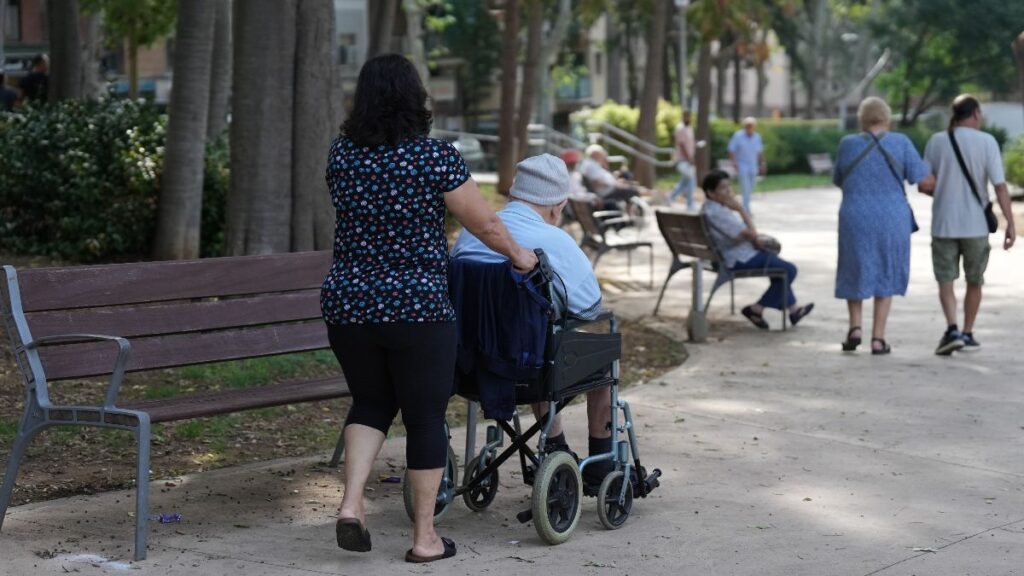
The economic problems that Spain is going through Due to high inflation and a slowdown in job creation, it has a strong impact on the pockets of millions of retirees and pensioners. People who either do not work because they have retired or are receiving disability and who have to tighten their belts to pay the rent, the mortgage, fill the refrigerator or the car tank and, if this were not enough, help their children.
These are the conclusions reached by the experts who signed the ‘V Cofidis Observatory of Economy, Sustainability and New Trends of Spanish Households in 2026’, which indicate that 30% of retirees do not save at the end of the month, and one in four is paying a mortgage or rent (25.4%). Those who do not own a home and must pay rent are 10.8% of the total, and 38.1% allocate more than 40% of their income to pay it.
In the case of being owners and having an active loan, the percentage reaches 14.6% of retirees who dedicate 15% of these, more than 40% of what they earn from their pensions, as stated, based on this report, by Europa Press.
Most of them only use their money, that is, they depend on what they earn through Social Security and do not usually ask for outside help. To be able to adjust and not end up with red numbers in the end, a good part of the elderly assure that they must cut back on other household expenses. A position that becomes more relevant when it is known that the majority of those who participated in the study (69.4%) own a home.
9% of retirees earn up to 1,000 euros per month
Regarding the saving capacity of Spanish retirees, the report indicates that 29% of households do not make ends meet, 30.8% save less than 10% of what they earn and 7% acknowledge saving more than 30%. When income is reviewed, 8.7% of retirees declare monthly net income of up to 1,000 euros (4.4% up to 600 euros and 4.3% between 601 and 1,000 euros).
When an unexpected expense appears, so do the problems in being able to face it. If it exceeds 1,000 euros, such as a breakdown in the car or in a sensitive area of the home, 9.5% indicate that they do not have sufficient resources to face it. 38.5% would have to ask for a loan from the bank or 26.7% would go to a family member or friend. 12.6% indicate that they would use a credit card to pay for it.
And what happens if the money to pay is greater? The vulnerability becomes more evident, and 22.9% would not be able to afford the expense of 5,000 euros and 29.1% would become bankrupt and go into debt assuming one of 10,000 euros.
30% would ask their children or family for help
28.8% of pensioners have to help their children or direct relatives who do not live at home, a contribution that is used to pay basic expenses (53.8%), rent or mortgage (25%), studies (19.4%), supplies (16.4%) and medical expenses (11.7%). What entails the most expenses is filling the refrigerator, and food accounts for most of the payments and is the first item of expense for more than half of the households (54.5%).
To this we must add the housing supplies, which are electricity, water or gas and internet with a disbursement of 29.2%. The two items are among the three main expenses, with close to 87%.
Social Security grants absolute permanent disability to those who are no longer registered, but requires 15 years of contributions and three of them in the last ten

Feijóo promises a revaluation of pensions even if the Spanish economy does not rebound: “we will get the money from somewhere else”
If the expenses of retirees are analyzed taking into account the Autonomous Communities in which they reside, it can be seen how in Aragon, the Basque Country, Navarra and the Principality of Asturias there is a good economic position according to the data from the Observatory. On the other hand, there would be the Canary Islands, Andalusia or Extremadura, with worse results.