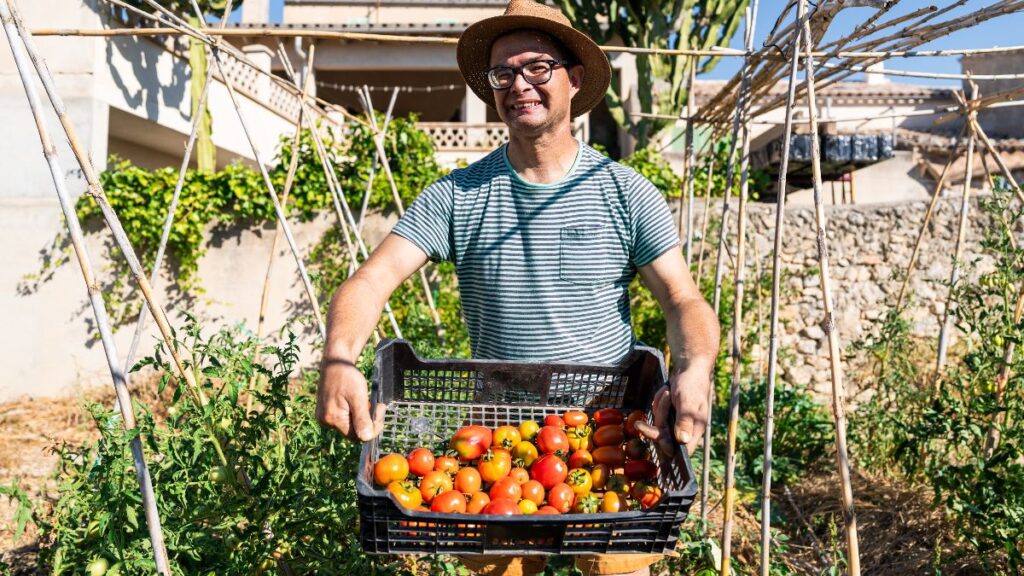
Agriculture is going through one of its most complicated moments in years. Added to the production costs and foreign competition, especially from Morocco in recent times, is the lack of generational change, with increasingly older farmers and many young people who do not see any motivation in this profession. For this reason, it is increasingly difficult to find people who want to basically take charge of agricultural operations, and even more so when they are aware of all the initial investment that is sometimes required.
Paco Mas, a young Valencian who grew up among orange trees thanks to his grandfather Faustino, knows this well. Although he worked as a civil servant, he continued to cultivate six hectares of land because, as his grandson remembers, it was what made him feel like a farmer. On Saturdays, Paco and his brother always had the same routine, which was none other than “lunch at nine and then three hours with grandfather in the field.”
When Faustino died at the age of 87, the orange was practically ready to finish growing, but no one in the family wanted to continue with the exploitation. “I thought: ‘This can’t be lost,’” Paco recalls in an interview for La Vanguardia, who decided to try to sell everything that his grandfather had prepared on his own.
A video on TikTok and 800 orders in two days
First he tried to sell the oranges through commercials, but the prices did not convince him. Since he had knowledge of creating websites, he decided to set up one in a simple way and recorded a video from the field itself explaining the story of his grandfather and offering the fruit directly to consumers.
The response exceeded any expectations. The video reached 400,000 views and in just 48 hours it received about 800 orders. “I didn’t even know where to go. People had already trusted and paid, so I had to comply,” he admits.
His grandfather’s old C15 ended up making “a thousand trips,” while the whole family was involved in preparing the shipments. However, that experience also taught him that selling directly did not mean keeping the entire price the consumer paid.
He sold the orange for one euro per kilo, but after deducting selection, storage, logistics and packaging, he estimates that he had about 40 cents per kilo left. From 8,000 kilos, he ended up getting approximately between 1,800 and 1,900 euros.
“If no one stays in the field, there will be no one to save it”
Despite now knowing much better about the difficulties of the sector, Paco does not believe that agriculture is doomed. “In agriculture there is money if there is a desire to work,” he assures, although he immediately adds that you also have to be willing to endure a period of important changes.
He is especially concerned about the loss of knowledge passed down between generations. “Today that wisdom is being lost and older farmers are very discouraged,” he explains, to the point that many tell him directly: “Son, leave the fields.”
Paco, however, wants to try just the opposite. “If no one stays in the field, there will be no one to save it. You can start little by little and grow as you learn,” he defends. He also believes that small plots of land will disappear and that the next few years will bring a “hard transition,” but he insists that there will continue to be opportunities for those who endure.
José (77 years old), homeless, has been sleeping on a bench for 3 months: “No one rents us anything because we are gypsies”
Air conditioning experts agree: “Leaving the heating on at minimum all day ends up increasing consumption”
But you don’t want to work without knowing what you’re going to earn each hour. “I don’t want to be a ‘go to the field and my time isn’t worth money’ farmer. I want to be an agricultural entrepreneur: invest, learn and create a model that works.” To which add that their main objective is actually “to survive and buy land.”