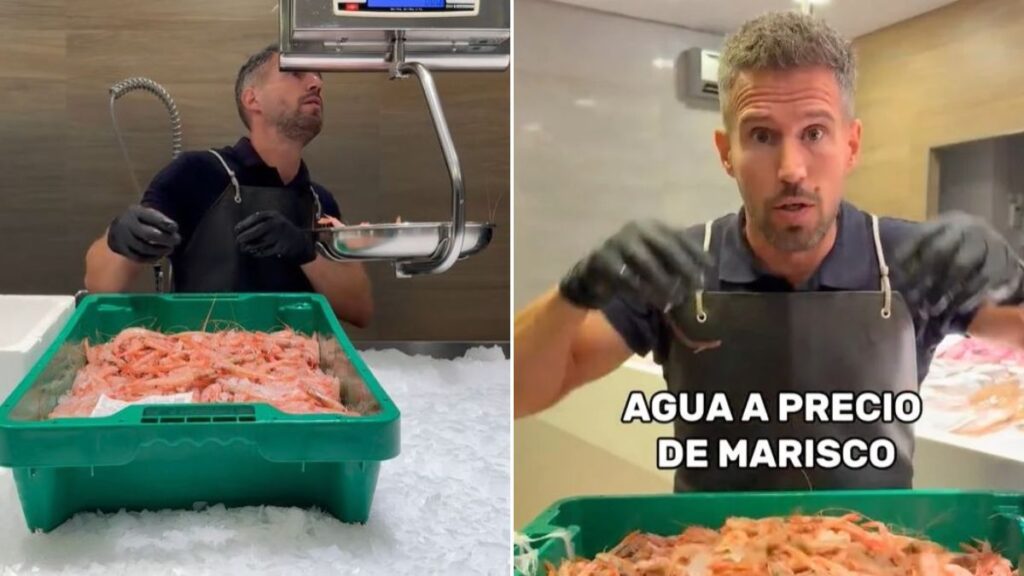
Buying a kilo of shrimp does not necessarily mean that all that weight corresponds to the seafood itself. At least that’s what José María Sánchez, a fishmonger, reports, who wanted to demonstrate how much shrimp can gain weight while they remain between ice and water during their conservation.
“They are charging you for water at the price of seafood,” says Sánchez in a video published on his TikTok channel (@naveganteofficial).
To demonstrate this, he does a fairly easy experiment, which is based on weighing 1.5 kilos of shrimp, then leaving them for about six or seven hours in a mixture of water and snow and then putting them back on the scale.
1.5 kilos of shrimp end up weighing 100 grams more
Sánchez explains that, “the seafood, once caught, is selected and put in boxes with a little ice so that it does not spoil” before reaching the fish market. “Then it is auctioned as is, that is, dry.” And after this he asks a question: “Why does it arrive to the end customer in water and snow?
Here is the key, and it is that the ice melts and creates a mixture of water and snow in which the shrimp can be preserved for hours.
Well, after leaving the 1.5 kilos of shrimp for six or seven hours in similar conditions, the fishmonger drains them and weighs them again.
The result it shows is that they now weigh 100 grams more. It seems little, but when you start counting the price per kilo, things change and this can give a lot of profit to those who sell shrimp at their stalls.
“If the shrimp is 30 euros, they are selling you 3 euros of water”
The fishmonger gives an example to understand it better. “If the shrimp is 30 euros, they are selling you 3 euros worth of water.”
Those extra 100 grams would be the same as 10% of a kilo. And the more expensive the product, the greater the amount of money associated with that weight can be.
The fishmonger gives red shrimp as an example, which can reach 200 euros per kilo. In that case, 100 grams would represent about 20 euros.
However, the preservation process itself requires ice to keep the product fresh during transport. Therefore, the question that Sánchez raises is not simply whether there is water, but how much weight the seafood can end up incorporating before reaching the consumer.
Nor does its demonstration imply that all commercialized shrimp gain exactly that weight or that all sellers carry out the same practice.
Barcelona City Council will give aid of up to 800 euros to buy bicycles and electric motorcycles to those registered from 2027

The Government equates single-parent families with two children with large families with a royal decree law
What it does put on the table is a question that few people actually ask when buying seafood, and it is nothing other than how much of what they are paying actually corresponds to the product itself and how much to the water that remains there after the process explained above.