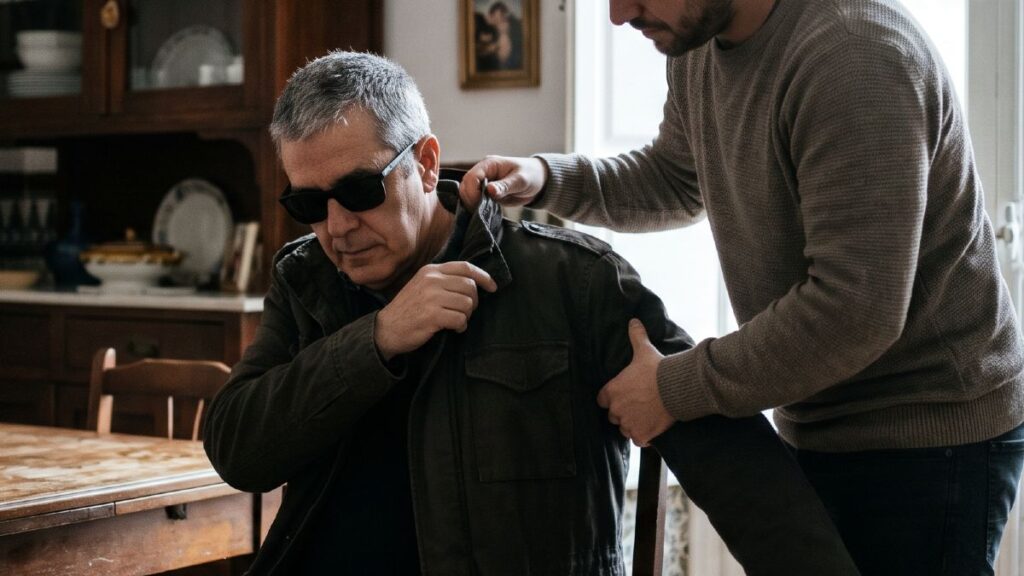
A worker, blind since he was young and who had been working at ONCE for 38 years, has managed to get the Superior Court of Justice of the Basque Country to recognize his pension for permanent disability due to severe disability (the highest degree). Thus, he will receive the maximum pension of 3,267.60 euros per month, plus a supplement of 1,470.42 euros to pay whoever helps him.
This man, born in 1965, has had a recognized disability level of 78% since 1985 due to retinitis pigmentosa (a genetic disease that gradually takes away his sight). In 1986 he joined ONCE, when his field of vision had already been reduced to 10 degrees in both eyes. That same year he began to work and did so non-stop for more than 30 years, at ONCE and in environments adapted to people with visual disabilities, until he left his managerial position in February 2024, as stated in the ruling (available in the Judiciary).
The problem is that the disease worsened, to the point of leaving him with vision limited to “perception of light and lumps”, to which are added mild hearing loss, an anxiety and depression disorder, and a hand disease that does not limit him. In March 2025, the Barthel scale of Basque healthcare was performed (tests to know how much you need the help of another person), giving a total of 65 points, so you had a moderate dependency and, in addition, degree II dependency has been recognized since 2008.
Despite the limitations and ailments, Social Security denied him any degree of disability in January 2025, seeing no “serious anatomical or functional reductions.” The worker went to the Court of Instance of Vitoria-Gasteiz where they agreed with Social Security, explaining that blindness was “the basic condition” that allowed him to enter the ONCE, and his work was supported by “adaptations, technical aids and a professional environment specifically designed for the disability”, without the worsening implying “a qualitatively different functional bankruptcy”.
Right to permanent disability due to severe disability
Regarding the permanent disability pension, the law explains that great disability or “great disability” is intended for those people who need “the assistance of another person for the most essential acts of life, such as dressing, moving, eating or similar” (it is included in article 194 of the General Social Security Law). The Superior Court of Justice also remembers that since 2023 the Supreme Court has asked that the situation of each worker be assessed individually, regardless of the illness they have, since the same ailment does not affect two people equally (in fact, Social Security does not have a list to give permanent disability).
For the court, the Barthel test demonstrates that he needs “great help” to be able to move and help to dress, eat or walk, that is, it represents “a habitual and reasonable need for assistance from third parties, with continuous supervision even within the home”, in addition to the fact that he cannot go outside without help.
Elisa Cardona, lawyer, on the profession when requesting permanent disability: “It is not enough to say I have this illness. It must be shown that my illness prevents me from doing these tasks of my profession.”

The BOE publishes the aid of up to 144,242 euros that the families of the Urda victims can collect, changes in sick leave and improvements in orphan’s and widow’s pensions
Here, in severe disability the same is charged as in absolute disability (100% of the regulatory base), with the difference that in this case a supplement is charged whose amount is calculated by adding 45% of the minimum contribution base and 30% of its last base, which in this specific case is 1,018.44 euros. Now, this supplement can never be below 45% of the pension (as regulated by article 196.4 of the same law), so in the end it remains at 1,470.42 euros per month.