
The Superior Court of Justice (TSJ) of the Basque Country has rejected the appeal presented by a businessman who was dedicated to the sale and purchase of vehicles and who faced a claim for 100,922.91 euros from the Provincial Treasury of one of the provinces of Euskadi, which corresponded to personal income tax (Personal Income Tax) of 2018 and 2019, in interest and penalties. The taxpayer defended that the money he had received from his company was the return of the contributions he had made to finance it, but the Court considered that this was not sufficiently proven.
The problem began after the inspection verified that the company was transferring money to the businessman and paying expenses that were private and had not been declared as income from movable capital. In total, 72,389.14 euros from 2018 and 123,043.89 euros from 2019 were regularized, understanding that these amounts had been obtained by being a member and that it was not proven that they came from the repayment of loans.
In ruling 298/2026, issued in October, the court supports the decision made by the administration, highlighting the deficiencies in accounting and the lack of documentation presented to be able to relate the contributions made by the businessman to subsequent payments.
When the sanctions were examined, it was pointed out that the situation was a ‘totum revolutum’, which means that the company’s assets had been confused with that of the majority partner.
The businessman said that his company would return the money borrowed
To understand the sentence, it must be taken into account that the affected person had begun to develop his activity as a natural person. In 2016 he built a company of which he was the sole partner and administrator and, as he stated in the lawsuit, what he wanted was to protect his personal assets and at the same time give greater visibility to the business.
In his statement, he confirmed that he had put money from his pocket and vehicles, although the operations were not formalized as capital increases but were registered as loans from the partner to the company in a checking account in which it was specified that it belonged to partners and administrators.
He pointed out that the company had repaid the debt in two ways, the first with transfers to his personal account and the second, by paying the expenses and debts that he maintained. He recorded these payments as a reduction of what his own company owed him.
He brought to the judge supporting documents for the transfers, vehicle documentation and even an accounting expert report. He alleged that he had declared all the interest corresponding to the financing and that the account balance at the beginning of 2018 came from previous years that had expired.
For the Treasury, this documentation was not sufficient since during the previous inspection contributions of 168,000 euros had been justified but there were other movements that were not accredited. But in addition, previous outflows of money appeared that did not allow us to verify whether the contributions had already been returned.
Doubts about payments such as loan repayments
The Court understood that it was facing a problem that went beyond the name of the account or the concept used by the businessman. The records and supporting documents were used to know what was happening and on this occasion, as reflected in the text, “serious deficiencies and gaps in the accounting of entries and exits were observed.”
For this reason, it was necessary to demonstrate that the refunds were still pending and that it was necessary to demonstrate that they were still pending refund and that the amounts that had been collected responded to these and yet intermediate movements appeared that prevented this relationship from being established.
So it points out that “a direct correlation cannot be established” between the balance and the partner’s contributions or the payments that had been made, even in his favor, including the personal payments that had been charged to the company.
The validity of the loan, the Court highlights, does not necessarily depend on whether it is formalized in writing. Without that document or that orderly accounting that supports both the inflows and outflows of money, the businessman’s explanation cannot be considered proven.
The prescription argument was not valid
The argument of prescription is rejected, because the regularization affects the income received and not declared in 2018 and 2019, and the fact that the account had movements and balance from past years did not allow the automatic transfer of the income to already prescribed years.
The sanctions are maintained, considering that it was not enough to pay the tax, but that they were supported by already proven irregularities and an incomplete justification of all movements. In addition, a possible ‘confusion’ was detected between the company’s assets and personnel.
The additional contributions to personal income tax amount to 47,108.26 euros, the interest rises to 6,776.39 euros and the penalties 47,108.26 euros, and together 100,992.91 euros are claimed. To this we must add the legal costs that have a limit of 3,500 euros, VAT excluded.
The Treasury allows two joined homes with different cadastral references to count as a single habitual home.
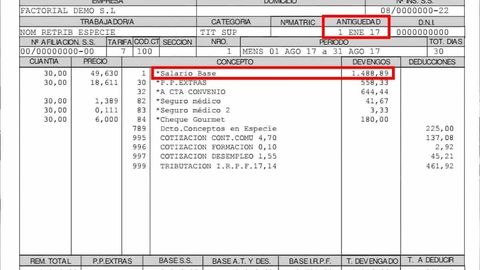
Starting in 2027, workers who earn 30,000 euros and have their salary raised by 3% will pay 5% more personal income tax, and the Treasury keeps almost 250 euros of the increase.
This resolution allows for an appeal within 30 days after the notification arrives.