
Housing is one of the biggest challenges facing the Government and current Spanish society. Buying a house is increasingly complicated for many families and young people as housing prices are at historic highs, and renting does not always offer an affordable alternative, meaning that the possibilities of accessing housing continue to decrease.
Protests and mobilizations related to access to housing have been added to this situation in recent weeks, especially after the eviction of Maricarmen, while the Government has tried to respond with two decrees that for many fall short. However, for some economists the current problem is not explained solely by what is happening now or in recent years, but by decisions made decades ago.
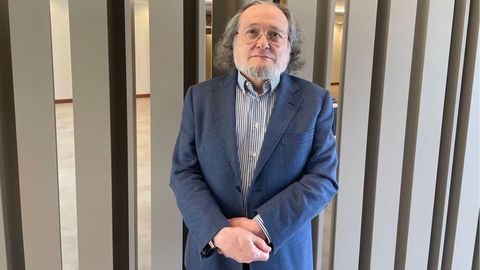
One of them is Santiago Niño Becerra, professor of Economic Structure, who in an interview on the podcast ‘I have a plan’, even talks about a specific date: “The housing problem in Spain was born on May 2, 1956.”
“We want Spain to be a country of owners”
Why that day?
Niño Becerra remembers that on May 2, 1956, the then Minister of Housing José Luis de Arrese granted an interview to ABC in which he said a phrase that would end up coming true but in a very different way, from the economist’s point of view, being the residential model that would end up dominating in Spain: “We want Spain to be a country of owners, not of proletarians.”
From there, he says that there was also another very notable moment and it was none other than the day the Urban Leases Law of 1964 was signed.
As he explains, that regulation left the rents “practically fixed and immovable” and the contracts could be indefinite.
“Do you think that a builder, with that law in hand, was going to build many rental homes?” he admits.
At the same time, Spain promoted protected housing even more. Between the 1950s and the 1980s, around 6.7 million officially protected homes were built, although Niño Becerra recalls that approximately 90% were for sale and barely 10% for rent.
“Spain became a country of owners and small owners of rental properties,” he summarizes.
The next big change came in 1985. “What the Boyer Law did was eliminate all the protection that existed on rentals up to that point,” he says.
“If you put restrictions and there is no offer, what there is ends up paying dearly”
For Niño Becerra, the consequences of that model reach directly to the present.
The economist maintains that the available rental supply was reduced by 61% between 2020 and 2025 and summarizes the problem with another phrase: “If you put restrictions and there is no offer, what there is ends up paying dearly.”
His diagnosis is quite pessimistic in this regard.
He estimates that Spain needs between 700,000 and 750,000 extra homes and considers that completely solving this deficit is practically impossible.
“It is impossible, this is incorrigible,” he says.
Although there are around three million empty homes, remember that many need comprehensive rehabilitation or are located in places with poor communications and where there is not the same pressure of demand.
As a reference for a different model, he puts Vienna, where there has been a strong supply of social housing for decades. It also compares Spain with countries like Austria or the Netherlands, where social housing was built with much longer protection periods.
Therefore, for Niño Becerra the problem falls especially on those who have not been able to become owners through a mortgage or by resorting to family help.
Santiago Niño Becerra, economist, on pensions: “The average pensioner who is joining the pension system today has an average pension that is 20% higher than the salary of the average young person who is currently joining the labor market”
Niño Becerra, economist, warns of what will happen to housing: “There will be a wave of evictions. In part it will be like in 2008”
“The young and not so young who are not owners are sold,” he says.