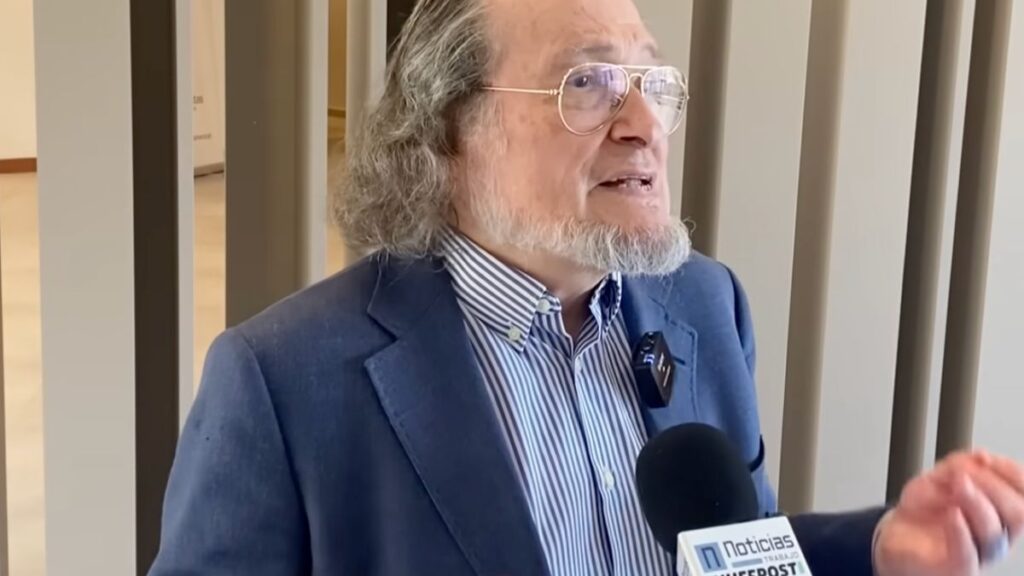
The retirement pension is calculated to replace the salary of those who stop working, but in many homes it also ends up serving to help other family members. The economist Santiago Niño Becerra, professor emeritus at the Ramon Llull University, points out in an interview in NoticiasTrabajo that “the pension has become an income for the pensioner, obviously, but it has also become financial support for the family.”
In the interview, Becerra defends that the current system “cannot be financed”, since it has a problem, which according to him, occurs “everywhere”, although in Spain it has an added bonus, which is that “the level of savings in Spain is very low”. It refers to what is saved for retirement, and the reason given is that salaries do not provide for more, since “the purchasing power of the average Spaniard is what it is.”
From there it goes to the family, explaining that “pensioners need the pension for themselves and to help the family.” And he gives it a proportion, “one household in three,” although in the interview he does not clarify whether it refers to the total number of households or only those in which a pensioner lives with other family members.
According to the Family Budget Survey of the National Statistics Institute (INE), which measures what each household lives on, although it does not include who each pensioner helps. In 2025, the main source of income was a pension (for retirement, disability or widowhood, among others, contributory or not) in 32.6% of households, and 25.1% of the population lives there, according to the INE table on the main source of household income. That is, one in three households and one in four people live primarily on a pension, and the figure also includes pensioners who live alone.
According to the same table, this proportion has fallen by just over two points between 2016 and 2025 (it was 34.8%), in parallel with the rise in self-employment, which has gone from 47.6% to 52.8% of households. For its part, Social Security paid 10,547,417 pensions to more than 9.5 million people in September 2026, with an average retirement pension of 1,576.1 euros per month, according to payroll data for September 2026.
Financial help to the family
Fundación Mapfre reaches a similar conclusion in the VI Senior Consumer Barometer, prepared by its Ageingnomics Research Center in collaboration with Google, where it indicates that more than half of those over 55 years of age (52%) financially help family members or close friends (the note can be consulted at this link). The study focuses on the more than 16.7 million people over 55 years of age in Spain, including retirees and people who continue to work, and describes this group as the economic support of their immediate environment.
For Becerra, the fact that the pension also has to support the family is “a really, very complicated situation.” When asked about young people, he believes that the pension system as it is known “is completely dying.” And he adds: “They are not going to have a pension.”
As of January 1, 2027, it will be necessary to be 38 years and six months old to retire at age 65 with 100% of the pension and without cuts by Social Security
Social Security denies absolute permanent disability to a 58-year-old crane operator with breast cancer and justice gives it to him with 100% of its base
Niño Becerra also separates the basic income from the pension (an amount of money to cover basic needs), which, according to him, “is not a pension, that is something else.”