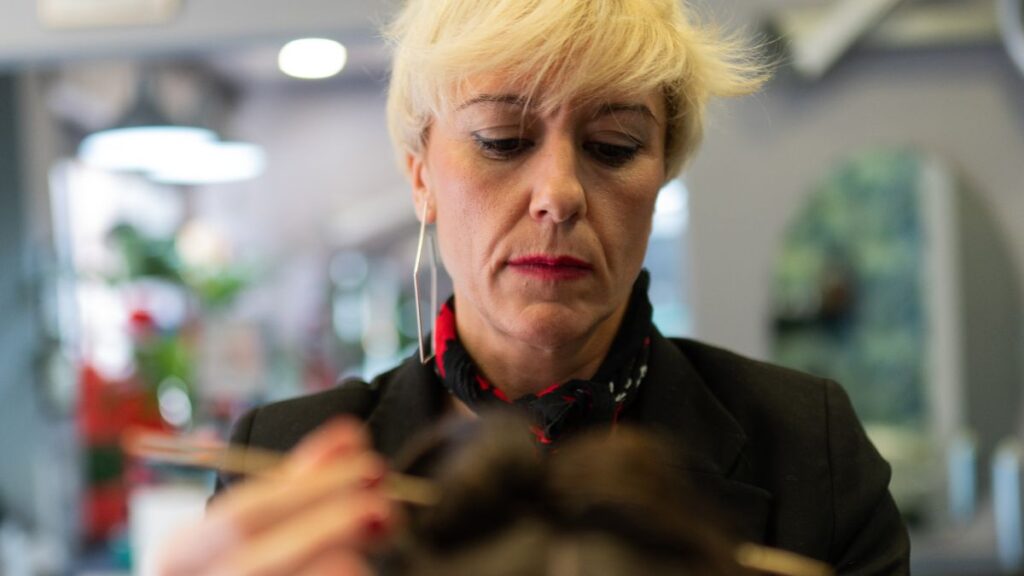
Maintaining good mobility in her arms and legs and being able to walk and stand has meant that a self-employed hairdresser in her 60s has been denied permanent disability despite suffering from persistent Covid and wear and tear on her lumbar spine, as well as fatigue, dizziness and memory problems. The Superior Court of Justice of Madrid agrees with Social Security, pointing out that these limitations do not prevent you from carrying out the main tasks of your profession.
The worker was contributing as self-employed under the RETA (the self-employed regime) and she had been suffering from several ailments such as persistent covid, spondyloarthrosis (wear and tear of the vertebrae), disc protrusions between L4 and S1 and bone edema in several vertebrae. Due to these and the impossibility of continuing to work, he requested permanent disability from Social Security, but this was denied by the Disability Assessment Team (the Social Security medical court) on the understanding that he had “injuries that do not constitute permanent disability.”
Although the Social Security medical report stated that the worker reported lower back pain, insomnia and pain in several joints, during the examination her gait was normal and the sciatic nerve compression tests were negative. Furthermore, a forensic report noted that no significant improvement could be expected in the short or medium term and that his long-term prognosis was “uncertain.”
The woman went to court, where neither the Court of Instance of Madrid nor later the Superior Court of Justice agreed with her, despite the fact that she requested at least that her total permanent disability be recognized. This, unlike the absolute one (which is charged at 100%), is received at 55% of the regulatory base (75% from the age of 55 if one does not work) and can be made compatible with other employment adapted to the limitations.
You can comb your hair even if you can’t make intense efforts
According to the ruling (available at this link), the TSJ relied on the forensic report, which stated in writing that the woman had limitations “for tasks involving intense or repetitive physical effort, tasks with high cognitive demands,” as well as for risky tasks. Regarding this, the Chamber remembers that total disability requires not being able to do all or the fundamental tasks of the job (it is stated in article 194 of the General Law of Social Security).
That is why he ends up concluding that the hairdresser “preserves the functionality of the lower and upper extremities, as well as the ability to walk and stand.” In other words, he can walk and stand.
The woman tried to argue that her other ailments had not been properly assessed, but the court explained to her that these could not be taken into account “as the factual account had not been modified.” That is to say, these ailments did not appear as proven facts in the ruling of the first instance (Madrid Court of Instance) and that is why the TSJ could only take them into account if she had expressly requested that they be added to those facts, something she did not do.
Social Security denies absolute permanent disability to a 58-year-old crane operator with breast cancer and justice gives it to him with 100% of its base
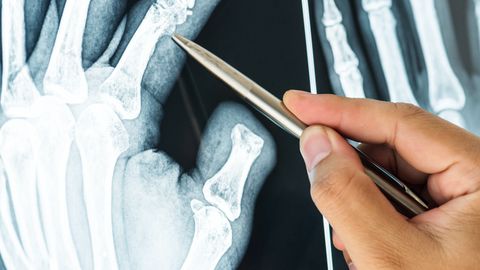
A seamstress receives 25,146.24 euros for permanent partial disability after being on sick leave for 545 days due to osteoarthritis in the thumb
For this reason, this woman was denied permanent disability due to persistent covid, but this is not always the case. The same TSJ of Madrid, in another ruling reported by NoticiasTrabajo, recognized the disability due to covid to a 42-year-old engineer with daily migraines and memory loss, with a pension of 3,194.46 euros. This is so, since Social Security does not have a list of diseases for which it grants disability, since it is based on how these limit the time of working.