

Add NewsWork in 
Professionals who for years contributed to an alternative mutual insurance company instead of Social Security, such as lawyers, solicitors, doctors or architects, will be able to transfer the accumulated rights to the public system to improve their pension, except for those who are already retired, who are excluded from that option.
The bill being processed by Congress opens an extraordinary and voluntary gateway, that is, a way to transfer the money accumulated in the mutual insurance to the public system and start contributing to the Special Regime for Self-Employed Workers (RETA), but, after the latest changes, it rules out professionals who already receive a benefit, one of the main demands of the affected platforms.

Retirees who receive 3,003.94 euros per month as a Social Security pension

The Government approves the flexible retirement that allows retirees to return to work and continue collecting their pension
The measure primarily benefits those who contributed the least to mutual societies during their careers and aspires to be approved before June 30, the date on which parliamentary activity is interrupted for the summer.
The rule, after the latest changes, does not convince any of the groups. The text allows these professionals to take the rights accumulated in the mutual societies and calculate how many years of contributions to the RETA that money is equivalent to on the minimum base. However, it does not include another of its great demands: that each year of contribution to the mutual insurance company counts as one year of contributions in the public system.
To make this conversion, a reducing coefficient of 0.77 will be applied, a factor with which it is calculated how many years of contributions to the RETA are recognized by the amounts transferred. The platforms demand to lower it to 0.67 to “validate” more years in Social Security, while the Union of Professionals and Self-Employed Workers (UPTA) has proposed setting the minimum equivalent contribution at 226.38 euros per month.
The underlying problem is that many of these professionals made very low contributions for years, lower even than those of a self-employed person in the RETA, so that when they retire they collect pensions below 700 euros and, in some cases, 500 euros. The transfer to the public system guarantees an improvement, but not necessarily reaching the minimum pension recognized by Social Security.
The new text does introduce some improvements. Eliminates the requirement to have been active in the mutual insurance company in December 2022, which expands the number of beneficiaries, and allows those who collect a widow’s pension to benefit from the gateway. Even so, it excludes already retired mutual members, who receive the lowest benefits.
The contributions to mutual societies will rise to 100% of the RETA in 2028
The law also reforms the operation of mutual societies. Once in force, mutual members will have to increase their contributions gradually until they equal the minimum RETA quota: they will contribute 86% in 2026, 93% in 2027 and 100% in 2028.
Furthermore, it obliges mutual societies to pay benefits no less than 100% of the minimum Social Security amount and to revalue them at the same rate as the public system. The alternative contribution system will disappear for new professionals, who must be integrated directly into the RETA as of January 1, 2028.
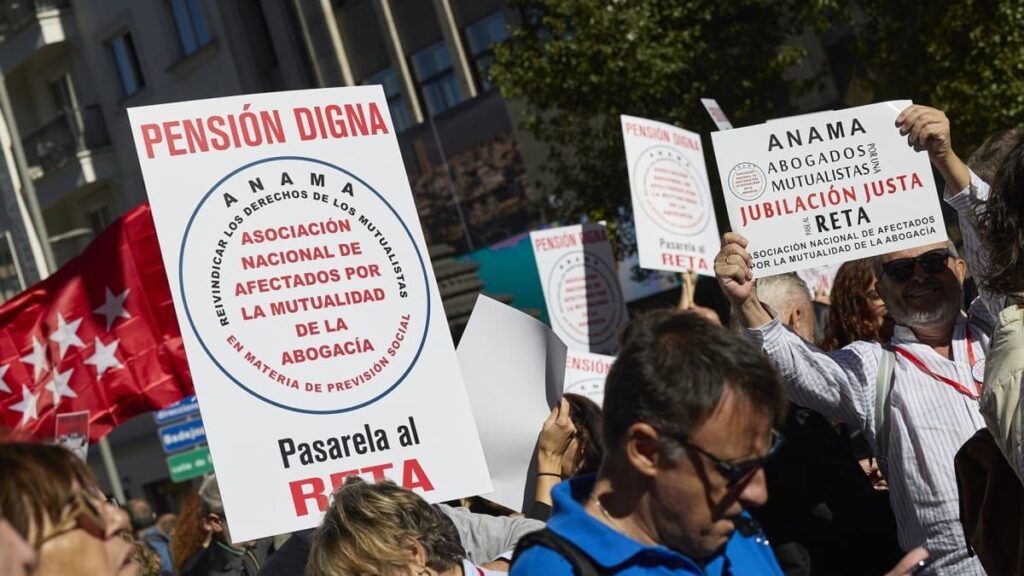
Congress reactivated the mutualists’ gateway after being paralyzed for almost a year and took the report of the presentation to the Committee on Labor, Social Economy, Inclusion, Social Security and Migration on May 20, a step prior to its vote in the Plenary and subsequent processing in the Senate. A day later, on May 23, the mutualists gathered in Madrid, from the Ministry of Inclusion to Congress, convened by the #J2 Movement under the motto “1×1 Catwalk for all”, to demand that the text include their demands before the final vote.