


Add NewsWork in 
Being on medical leave or more technically known as temporary disability, guarantees workers to collect a benefit while they cannot work and receive health care. However, the fact that this benefit is collected does not mean that it can be extended indefinitely or overlap with other contributory Social Security benefits. In this sense, if the sick worker reaches retirement age and decides to retire to collect his retirement pension, Social Security will suspend the payment of medical leave.
This is stated in article 174.1 of the consolidated text of the General Social Security Law (which can be consulted in that Official Gazette), where it literally explains that the right to the subsidy will be extinguished by the recognition of the retirement pension.

Social Security suspends payment of temporary disability leave to workers who abandon medical treatment without justification

Validated: the sick leave and pensions recognized for the Adamuz and Gelida accidents will be recognized as work accidents
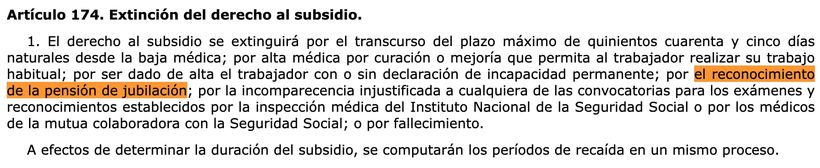
In this way, those workers who are on sick leave and reach their ordinary retirement age, choosing to request said lifetime pension, will see how they stop receiving temporary disability, since they stop being workers and acquire the status of pensioners.
The law explains that the ultimate objective of temporary disability is to cover the lack of income that a worker suffers while he recovers to return to work. Therefore, the benefit acts as a temporary replacement income. If the worker processes his retirement, the system understands that his departure from the labor market is now definitive, so it makes no sense to maintain a benefit designed to “reintegrate.”
Temporary disability in cases of early and delayed retirement
In cases of voluntary or involuntary early retirement (which occurs before the ordinary age), the temporary disability benefit is extinguished at the time the retirement pension is recognized. That is, it does not change with respect to the ordinary one.
For delayed retirements (those that occur beyond the ordinary age), the situation changes. Since they have not requested the pension (and, therefore, there is no official “recognition” of it), they continue to be active workers. If they suffer an illness or accident, they will be able to collect medical leave normally. The subsidy will only expire on the day they decide to end their working life and their retirement pension is formally recognized.
A practical example
To understand how this rule affects our daily lives, we can use the following practical example. Let’s imagine a 66 and a half year old worker who suffers a serious fracture and goes on temporary disability leave.
While you are immersed in your rehabilitation process, you reach the ordinary retirement age that corresponds to you (for example, 67 years old) and decide to apply for your retirement pension at the INSS. At the same time that the National Social Security Institute issues the resolution recognizing your right to a retirement pension, your right to continue receiving medical leave will be extinguished. For practical purposes, you will not be left helpless, the INSS will simply stop paying your temporary subsidy and will begin to pay you your lifetime retirement pension.
Other reasons why your temporary disability ends
The transition to retirement is not the only reason why they withdraw your sick leave aid. The regulations establish in article 174 that the right to the subsidy will also be extinguished if the following situations occur:
- For exhausting the maximum time: The right will expire after the maximum period of 545 uninterrupted calendar days has elapsed since the medical leave began.
- Due to medical discharge: Either due to cure of the disease or due to an improvement that allows the worker to return to carrying out their usual work normally.
- For unjustified non-appearance: If the patient does not appear, without a valid excuse, at any of the calls for medical examinations and examinations established by the medical inspection of the INSS or the mutual collaborator.
- For becoming permanently disabled: If the worker is discharged with a proposal and subsequent formal declaration of permanent disability, a situation that will replace the temporary sick leave.